Friday, 5 April 2013

Torres del Paine: Grandeur, Guanacos and Gauchos

[The weather has been  glorious in Stanley this week, but a cruise ship, Veendam, has yet again cancelled a visit, which has meant more time for me to sort out photos from a recent trip to southern Chile....    This blog recounts some episodes of my life in the Falkland Islands.  This chapter covers a week in Chile.  It's a bit longer than normal, as I thought the scenery worth sharing, and it may be the last for a while due to mundane activities getting in the way of publishing a blog.....]
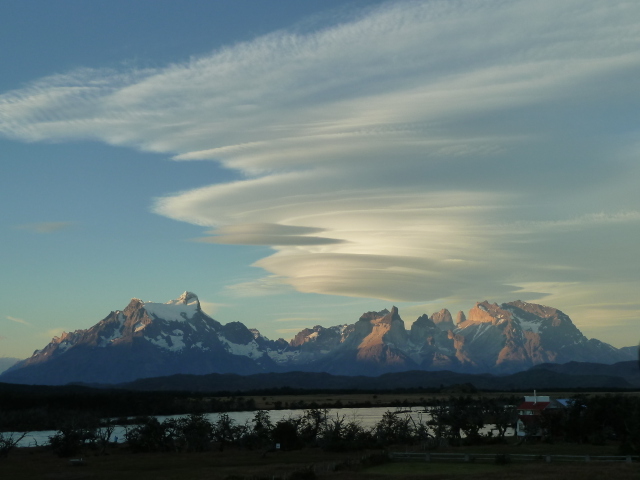
Lenticular clouds above Torres del Paine National Park
"Torres del Paine is not a mere park, but a park of parks, a destination of travellers to whom a park is more than a place in which to be entertained, but rather an  experience to be integrated into one's life.  Torres del Paine is the sort of park that changes its visitors....."
...........from South American National Parks, quoted by Sara Wheeler in "Travels in a Thin Country", a great insight into Chile.   They are not wrong!
The park is home to thousands of Guanacos
One of the reasons my wife and I wanted to live in the Falkland Islands was....to get away from the place!  No, seriously, one reason for moving there was for the opportunity of seeing South America, which otherwise would be beyond our reach.
Andean Condor, biggest bird in the Americas...rarely seen on the ground.
The Falkland Islands are about 350 miles east of South America, and there's a weekly flight to Chile, operated by LAN, which is the only flight away from the island, apart from the regular one to RAF Brize Norton in England.
So, if you ignore the 35-mile bumpy drive to the international airport at Mount Pleasant, and the long, dull wait before the flight, it is quite a convenient way to start explorations of South America.
Similar in size to the English Lake District....
Our flight continued on to Santiago, but we disembarked at the southern Chilean city of Punta Arenas on the Straits of Magellan.
Unusually calm lake.
Our destination that evening was Puerto Natales, a 3 hour bus drive to the north across the flat Patagonian country that looked similar to the Falklands.  Puerto Natales is about 2 hours drive from the Torres del Paine national park.  Next morning, we had an early breakfast overlooking the fiords and mountains, and then continued on to the park.
Los Cuernos - The Horns
As we got closer to the park the landscape changed dramatically, and snow-capped mountains loomed in the distance.
Grey granite, below. Brown sandstone above.
Soon we entered the park and enjoyed the incredible scenery the park had to offer.....
Salta Grande (people at lip of Falls). A waterfall between two lakes.
The main massif in the park is not part of the Andes chain of mountains, but a separate, albeit adjacent, geological feature.  It was formed when molten magma forced its way up and into the layers of sandstone, then cooled forming a 2,000 metre layer of granite, sandwiched between the older sandstone!
The Horns, from the south. Grey granite, brown sandstone.
The whole massif was  uplifted when continental plates collided.  Ice caps covered the land for millions of years, and eroded the rocks into dramatic shapes.  When the ice melted about 10,000 years ago (roughly about the same time Man first reached this region), the underlying granite was exposed.
Bring your own seat, for one of the best views on Earth.
And so, we are left to gaze at Nature's beautiful creation......

It's like a gigantic Pavlova with a chocolate topping!
"Beef or Chicken?" Chilean style
Talking of food...... lunch was taken in a  beautifully-located lakeside restaurant, with panoramic views.  We sampled the traditional Chilean grill, and were offered the choice familiar to many long-haul travellers, of "beef or chicken?" !  What it did show was how easy it can be to deliver delicious food to hordes of visitors all arriving at once.

After lunch, we explored more of the park by bus.  The gravel roads were twisty, narrow and undulating, but much of the park has no roads and hiking and horses are the main modes of transport.
Lunch with a view
Coming around one bend, our guide suddenly asked the driver to pull over and let us get out to take photos.  We couldn't understand why she was so excited, taking photos of the mountains herself.  Surely she had seen this view hundreds of times?  "Oh yes", she agreed, "but never reflected in that lake.  It's always so windy!  Today is special!".
Reflections from our trip....
deliberately left blank!
Icebergs!
Another famous lake, Lago Grey, has a glacier at one end, and the wind has blown icebergs from it, 15 miles to the other end of the lake!  The place is notorious for the strong winds.......
Lago Grey.  The rickety pier for the Glacier boat trips.
Horses are popular form of transport.
Eventually, we had driven about 40 miles from north to south within the Park, and were dropped off at our hotel near the southern entrance, whilst the bus returned to Puerto Natales.  Prior to travelling, I had checked the map and had concerns that our hotel was too far away from the mountains to get good views.  I needn't have worried!!
The hotel had panoramic views of the park, and we were soon treated to a display of lenticular clouds, which occur fairly often in these windy latitudes.  They are caused by high winds being forced up over mountains.
Sunset, moon and lenticular clouds.
Dawn on the Horns.
The next day we took a zodiac trip down the Serrano river.  Although not really "white-water rafting", we had to get inside a wet suit and wear life jackets, in case we fell out the boat.
Ready for anything
The river skirts the edge of the Southern Patagonian Icecap - the biggest in the southern hemisphere outside Antarctica - and we could see numerous glaciers flowing down valleys to calve into the river.
Serrano Glacier
Without the boat, access would have been difficult and time-consuming.  There are no roads.  This area was one of the most remote in South America, and one of the last places where Europeans migrants encountered indigenous people.  Sadly, about 100 years ago, most of these people succumbed to the usual cocktail of introduced diseases like smallpox.  So the area remained a wilderness, until tourism began about 20 years ago.
Glacial ice blocking the outflow of the lake.
Now, the region is mostly National Park.  The Torres del Paine park abuts the vast Bernardo O'Higgins National Park (13,000 sq. miles, compared to 927 sq. mls for Torres).  By the way, in my old stomping ground of Richmond upon Thames, London, there is a statue of Bernardo O'Higgins, a former resident who went on to liberate Chile from the Spanish!
The end of the glacier
 The closeup views of the glaciers tumbling down the mountains allowed us to see how much they had retreated in recent years.  Spectacular...... but better was to come!

Rickety bridge and person with vertigo.....
On subsequent days, we tried to do less-sedentary activities, and the main one in the park is hiking.  The paths are well-signposted,  with time and distances to the next viewpoint or camp-site clearly marked.

 However, apart from occasional bridges and rustic hotels, the park is very unspoilt and the landscape is undiminished by the growing number of visitors.
Spanish - English directions
We were to see several birds and plants which we were familiar with from the Falklands.  Most had different names, but it is clear some have migrated across the ocean from Patagonia at some point in the past.
Well-marked paths
One aspect of the wildlife we noticed that was similar to that of the Falklands', was that it was not frightened of people, and didn't run or fly away until we got very close.
Black-faced  Ibis. Familiar to Stanley residents...
Quite the opposite.  One evening, we watched two Patagonian foxes run around chasing hares for about 20 minutes, sometimes walking between groups of people and coming within touching distance of us.
Patagonian Fox hunting hares at night.
Patagonian Fox walking past us in the dark...
Hare!!  One of many.
Don't stand on the wildlife...
On one walk, there was a little mouse in our  path which didn't seem the slightest bit bothered by our presence.
"O, wee, cowerin', timorous beastie!" Rabbie Burns.
The Caranchos are scavengers and quite common on the Falkland Islands, away from settlements, but these were spotted very close to our hotel, so were obviously adapted to live off our scraps.
Southern crested Caracara. (Carancho)

Ready for the gauchos
 Horses were used for getting about, and tourists could learn to be gauchos for the day, or even head up into the hills for a camping expedition.  I usually sneeze when near horses, so declined the offer of a day in the saddle.
The trainee gauchos head off for the day....
Near our hotel was a large hostel and camp-site, with a shop and restaurant.  There was also one of those world maps, where you can post up where you come from, although there seemed to be some dispute on whether the Falklands were part of Argentina or not.
The political debate even reaches a hostel in the park.....

A board in the hostel, showing where everyone comes from....
 Peter the Penguin, posting from Antarctica, and someone from the  Islas Malvinas, Argentina, oops, The Falkland Islands....  You just can't get away from politics!

Misty dawn
So, I hope this has whetted your appetite, as the most spectacular part of our trip is yet to come.   More soon, domestic chores permitting....

Peter

Monday, 1 April 2013

Easter Greetings from East Falklands

[This is an irregular diary of a life in the Falkland Islands.  We arrived in January 2012, and still being surprised by the islands, the people, the wildlife  and the earwigs!]

A major breakthrough in home entertainment appeared in our homes last week - the arrival of mainstream UK TV channels.  We take the signal broadcast by British Forces Broadcasting Service.  No longer do we get a single channel of popular programmes, interlaced with news from Helmand province, Afghanistan.  The downside is - adverts, programme clashes, and, possibly, a TV Licence....
Moonrise
Last week has seen clear skies, which have produced some wonderful sun- and moon-rises.  With the passing of the Equinox, the days here are now getting shorter, with sunset around 7pm (local time, which is now 4 hours behind British Summer Time!).   Sunrise is about 7:15, and getting later by the day.  Temperature is mid-teens (unlike the UK).
Snoozing seal
Knowing that it will soon be too dark to walk in the evening, and that much wildlife is heading away for winter, we've taken the opportunity of the recent good weather to walk on the local beaches as much as possible.   We've been lucky enough to get closeup views of a snoozing (female elephant?) seal, and a slightly lost Gentoo penguin.
Beach meeting
There's a colony of Gentoo penguins near Stanley, but that beach is mined, so close encounters there are not possible.  But, Surf Bay, where these photos were taken was de-mined about 3 years ago.  The squad of men, mostly from Zimbabwe,  who perform the de-mining are back again and clearing some minefields at the other side of Stanley.  What a job, but they do earn the gratitude of residents here.
Heading back to sea.  Flightless steamer ducks look on.  Who needs to fly?
Other unusual visitors are the cattle egrets, and I saw my first of the year this week in our garden.  It must have flown all the way from South America, at least 350 miles to the west.  Unlike local birds, these visitors tend to be difficult to get close to.....
"Egrets?  I seen a few.  But, then again, too few to mention...." (after Sinatra).
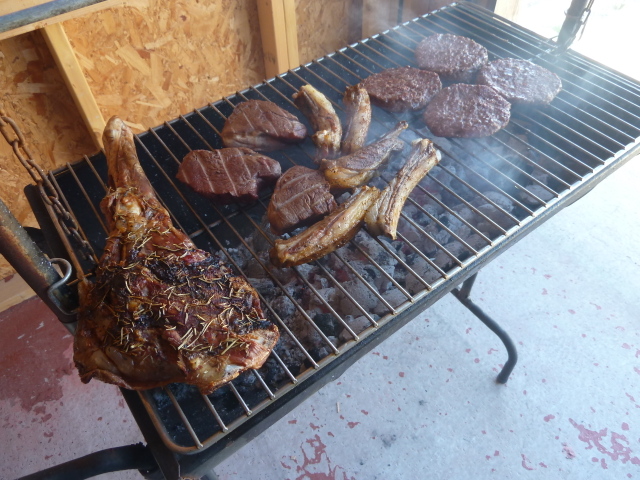
Another unusual event was a barbecue held in a friend's large garage.  Although it was sunny and reasonably warm (for the Falklands - one guy wore shorts!), it was breezy, so the grills were moved inside.
Man at work
The food was delicious, with plenty of salads to accompany the copious amount and variety of meat.
Sausages, burgers, steak, chops....
There was sufficient drink, as well........
Leg of lamb, ribs, fillet, rib-eye.....etc.
As an added bonus, we were treated to a low-flying Hercules aircraft, which 'buzzed' the airport at Stanley about 3 miles to the east, and then roared across the harbour.
Meanwhile,  the ongoing battle with earwigs was racked up a notch when we called out the man with the insecticide, who sprayed all around the outside of the house.   The earwigs arrived in the Falklands about 5 years ago in a consignment of wood, and are breeding very successfully, as they have no enemies, except Man.  Maybe we need to import some hedgehogs.....?
Low-flying Hercules

On a serious note, the local paper, Penguin News,   http://www.penguin-news.com/  had a lead story of a policeman being accused of several assaults during a large disturbance in Stanley, last year.  Despite an estimated 50 people engaged in knocking lumps out of each other, after a night in the pubs, only this policeman seems to have been charged with any crime!

The Senior Magistrate believed the wrong man was in the dock, and, at the end of a two-day trial, found there was no case to answer on all 4 charges. All very odd......

Still in their burrow at Easter!  Time to migrate, guys!
Elsewhere in Penguin News, there are job adverts galore for Accountants.  So, if anyone of that persuasion is interested in working and living in a unique environment, get your CV submitted!

Easter Monday is not a Public Holiday in the Falklands, but we get other days to compensate:.... The Queen's Birthday, Peat-cutting Monday, Liberation Day....!   Enjoy Easter, wherever you are!

Peter