[This is a diary of a life in the Falkland Islands, in the south Atlantic. Last month, we headed north to re-visit the UK (of which, see next blog), and stopped en route on Ascension Island for some heat and history (naval and natural). Flights to and from the UK (and the Falklands) refuel here. It may not look far on a map, but the Falklands are further from London than Hawaii or Bali!]
We began our journey with an escort................
 |
| A close encounter of the Falkland's kind.....(courtesy of the RAF). |
Ascension Day is celebrated around 40 days after Easter. In 1503, on Ascension Day, Portuguese sailors sighted a bare, volcanic island in the middle of the Atlantic, just south of the Equator. They found fresh food in the shape of Green Turtles laying eggs on the beaches.
Five hundred years on, Ascension Island is still barren and in the middle of the Atlantic, and Green Turtles still lay their eggs on the beaches, but some things have changed since 1503...
For more detail on the island, try here >>
http://en.wikipedia.org/wiki/Ascension_Island
 |
| Falklands to Ascension I. - about 8 hours' flying. |
Ascension Island is a remnant of the British Empire - where the Royal Navy ships could re-supply with food and water while commanding the seas between the UK and Africa and South America. It's also the remnant of a huge volcanic upwelling from the mid-Atlantic Ridge, about 1 million years ago. The island of Jersey, in the English Channel, is slightly bigger, and has more people - 90,000 compared to less than 900 on Ascension.
 |
| London - 4,830 miles.. |
It's a long way from anywhere, but handily for Falkland Islanders, its position about halfway between themselves and London enabled the island to be used as a refuelling stop by ships and aircraft heading to rescue the Islanders from Argentinian invaders in 1982. However, there is a strong American presence on the island, and the then US Secretary of State, Alexander Haig, reportedly offered to allow the British Task Force to land on Ascension, before being brusquely told that Britain did not require US permission when using one of her own islands!
 |
| Ascension Is. - volcanoes and satellite dishes... |
The island's strategic, if lonely, location has meant it has been vital in providing a link between the continents, and latterly, tracking satellites. The telegraph cable between London and Cape Town came through here, and many others followed. It was virtually a private fiefdom of Cable & Wireless, the communications company, for many years, before becoming a UK Overseas Territory.
The Americans are there because during the Second World War, they built an air base (called "Wideawake" - the name for the terns who breed here in their thousands) which allowed planes to fly safely across the Atlantic to the North African and European theatres of war.
 |
| Ascension Is airport transit lounge. |
After the war, the base was abandoned to the turtles, terns and telecomms people, but when the Space Race escalated in the '50s and '60s, Ascension Island provided a vital link in the chain of tracking stations which monitored Russian and American spacecraft.
 |
| Government House, Georgetown. |
I believe the CIA (and GCHQ) also monitored the airwaves there, but now the BBC and the Ariane Space Project continue to have installations. There is still a US Air Force base, as well as an RAF presence. Add in civilian workers (mostly from St Helena), and the population totals about 800. There is no indigenous population, and no-one can live there unless they have a job.
 |
| Lunch arrives..... |
It's a very relaxed outpost, and within minutes of arriving, we had wandered a few hundred yards through the tiny capital, Georgetown, from the only hotel to the pier and watched fishermen bring ashore the day's catch!
 |
| You can't get any fresher than this! 30 minutes from sea to table. |
A 200-pound tuna was just being dragged up the steps to a steel table, where the fish was quickly converted into tuna steaks. I had a couple of these during our stay and they were the biggest and tastiest tuna steaks I've eaten, not to mention the freshest!
 |
| Freshly-caught Wahoo or....... Barracuda. |
While we were watching the fish being worked on, we gazed along the idyllic-looking sandy beach with the Atlantic swell breaking gently on it. We also noticed many black fish in the crystal-clear waters below. We entertained thoughts of going for a cooling swim or snorkel, until we watched the remains of the tuna being heaved into the sea.
 |
| Trigger fish disposing of the leftovers. |
There was an immediate feeding frenzy on the carcass as hundreds of fish converged on the remains. All thoughts of going for a paddle in the sea were dismissed!
However, there are a few activities on the island, other than feeding the fish, to keep one entertained. Apart from playing the "worst golf course in the world" - the greens are made of brown volcanic rock - there are many interesting walks. Some fellow Falkland Nordic Walkers had visited the island last year and told me about the great walking on Green Mountain........
 |
| Ascending Green Mountain |
Green Mountain is just under 3,000 feet (900m) high, and there is a very twisty road most of the way up. The road takes you from sea-level, and the arid interior of the island, through scrub, to a verdant forest surrounding the summit.
 |
| 30 hairpin bends on the mountain road! |
When Napoleon was exiled to St Helena (800 miles to the south-east) in 1815, Royal Marines were stationed on Ascension Island to keep lookout for French frigates on a rescue mission. Green Mountain gave the best vantage point, and the Marines created many paths around the summit. A great feature of these paths, is that they are on the same level around the hill, with many tunnels cut into the solid rock to avoid walking beside a sheer cliff-face.
 |
| Green Mountain |
One of the drawbacks of the island is the lack of water, and many attempts have been made to find springs or collect the rainwater. Nowadays, a desalination plant provides sufficient water, but for centuries the arid island made life difficult for sailors.
 |
| Not a common sight in the Falklands, but a roadside plant here! |
However, after a visit in 1843, Joseph Hooker suggested that Kew Gardens send as many plants as possible to encourage greenery and, hopefully, rainfall. And so, the mountainside is festooned with an eclectic mix of trees and shrubs from around the globe - pines, eucalyptus, bamboo and bananas all thrive there. And the plan worked - a cloud forest now envelopes Green Mountain!
 |
| Light at the end of the tunnel |
We followed a trail which was almost level at about 2,500 feet. A brisk hour-long walk would give a 360 degree vista of the island and surrounding ocean, so the Marines' efforts seemed worthwhile, and Napoleon was never rescued!
 |
| Narrow cutting |
The foliage was constantly changing, too, with rock walls covered with maidenhair ferns, and huge ginger plants in bloom.
 |
| Ascension lily |
What also made the walks interesting was a number of letterboxes. These may have begun from the tradition of leaving letters on islands for other passing ships to take back to their destination. But, more likely, from the letterboxes on Dartmoor, Cornwall, which provide entertainment for walkers there.
 |
| One of the many letterboxes on the island. Note width of path. |
The boxes have notebooks inside them, and visitors can leave messages for posterity. Guide books and leaflets on these walks can be obtained from the excellent museum in Georgetown.
 |
| Emerging from a tunnel |
On the western side of the summit, the path was much wider, to allow American jeeps to service the secret radar installations erected at the end of World War 2. However, the eastern section of the path was only wide enough for single file, and we were very surprised to find 3 mountain-bikers heading rapidly towards us at one narrow point. People have died falling off the mountain!
 |
| Bamboo abounds |
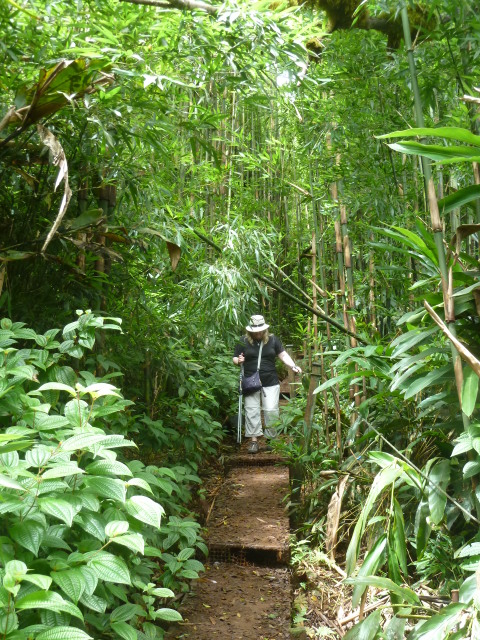
Another path connected with ours, and it took us the couple of hundred feet up to the summit. However, as we gained height we entered a very dense, dark and damp bamboo forest.
 |
| A boardwalk helps get through the bamboo forest. |
The contrast with the aridness of the island a few miles away was startling. Despite the heat (36C) of the coast, I preferred it to the sweltering humidity at the top of the mountain.
 |
| Land crab at 800m (2,500ft) above sea level. |
Every so often, we came across the strange land crab, which lives its life in holes on the mountainside, miles from the sea. About 3 times a year, thousands emerge from their burrows for a huge get-together on a beach. It's thought they wait for the full moon....
 |
| Unusual sight for Falkland Islanders - tarmac roads! |
As well as plant species, many animal and bird species were brought the island over the years. Some survived well, but were later abandoned as people came and went. Feral sheep and donkeys are quite a common sight. But others, such as ostriches and guinea fowl, weren't quite so successful at eking an existence on extinct volcanoes. An exception was the mynah bird, brought as a house pet from India, which is now probably the most common land bird.
~~~~~~~~~~~~~~~~~~~~~~~~~~~~~~~~~~~~~~~~~~~~~~~~~~~~~~~~~~~~
 |
| In for the long haul.... |
But the animal that has been coming to Ascension Island long before men found it is... the Green Turtle. Despite their very slow speed on land, precise numbers are difficult to estimate. But certainly several thousand congregate offshore to mate in February and March.
 |
| Making tracks....... |
The turtles swim about 1400 miles from the Brazilian coast to mate in the shallow waters around the island. The females may mate with several males (and each male can fertilise her eggs, so a nest of 150 eggs might have 5 or more fathers! By the way, no males come ashore. Typical...).
 |
| In the nest. |
Between March and June, the females come ashore at night to lay their eggs in deep pits. It was easy to wander down to Long Beach in Georgetown before dawn and find the stragglers trying to finish burying their eggs in the sand, before hauling themselves back to the safety of the sea.
 |
| No shortage of fresh eggs here! |
About 150 eggs are laid at a time and some females lay about 5 times! Guided tours of the beach are held a couple of nights per week, when experts explain the lifecycle of this amazing creature.
The turtle population seems to be increasing after centuries of persecution, mainly by the Royal Navy. Many thousands of turtles were captured and kept in seawater pools near the beach (they are still there) to provide fresh food for passing sailing ships. Until about 1920, when the damage to the population was recognised, turtle soup was a traditional starter at special Royal Navy dinners,
 |
| The welcoming surf |
After about 2 months, the eggs hatch - all at the same time! Buried under about 5 feet of sand, a baby turtle couldn't dig its way out of the nest. So, the key to survival, and life, is for the all 150 hatchlings in a nest to push each other up to the surface.
 |
| "OK, lads. The coast is clear. Run for it!" |
They then emerge, or "erupt", together, and make a dash to the sea, where they can begin their lives. Or not, if the frigate birds have their way.....
 |
| A nest erupts. No need for long lenses. |
Most "eruptions" of hatchlings occur at night, when predators are asleep, and perhaps because the moon is reflected on the sea and provides a beacon for the turtles to aim for.
 |
| Bird food. |
However, we witnessed an eruption during the day, and it was easy to see why it's thought only 1 in 500 turtles make it to adulthood. We saw one little turtle on its back, and knowing it couldn't turn itself over, I intervened to give it a chance in life....
 |
| A helping hand |
If you want to know more about the turtles, this is a good site >>
I had a funny encounter on arrival on Ascension Island - a place I'd never been before. The hotel had a pleasant outdoor bar, and I was just about to catch the barmaid's eye to order a bottle of "7 Giraffe" beer (from Alloa!) when an attractive young woman sitting at the bar said - "Hello, Peter!"
I was somewhat taken aback that someone in this remote spot could possibly know me, but felt sure I had met her somewhere before: just couldn't, for the life of me, remember where. She interrupted my thoughts about early-onset senility, by reminding me that we met briefly in Stanley about 2 months earlier. Phew!

Small world!
Her plan was to soak up the sun for a week - delaying the return to the UK's cooler climate as long as possible. I, on the other hand, wasn't that keen on the heat, and longed to be in England, now that Spring was there..........
More anon,
Peter,
(now back in snowy Stanley having skipped from Autumn to Spring and back to Winter in a month).