Showing posts with label seal. Show all posts

Tuesday, 1 October 2013

Sealion Island - Where giants collide.....

[Another episode of an expat's life in the Falklands.  This week, we had a flying visit to an outlying island, with a good lodge on it - Sealion Island.   Outside, was the wildlife.....]

If you look back to older blogs, you may find that I have posted about Sealion Island twice before.  We have visited it in the last 2 Februarys, but this time we were going at the start of Spring, rather than the end of Summer.

Watchful penguin
Sealion is about 50 miles south of Stanley, off the south coast of the Falklands.  In February, the  breeding season was at an end - the chicks and pups had either left or were about to set off on their big adventure.

"Sorry, we haven't seen your mate"
The adults were regaining their strength and renewing their feathers or fur, so that they could survive the coming winter.
But, this month is the start of Spring, and some visitors had already produced a new generation.
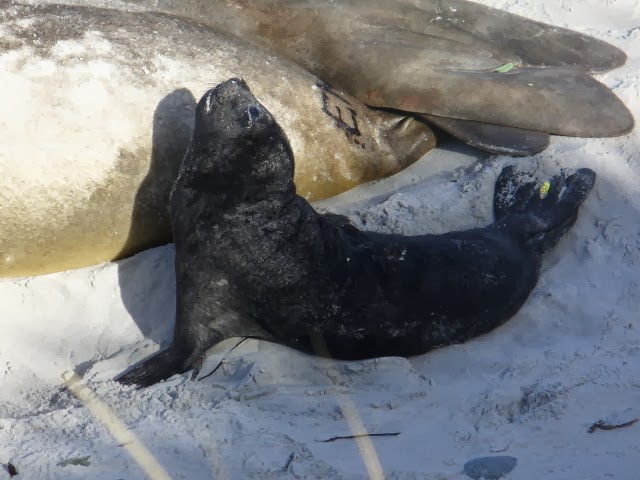
Male Elephant Seal - 3 tons, female, (1 ton) and pup (45kgs)
Huge Elephant seals were dotted along the beaches, with a few dominant males gathering harems around them.  We saw about 20 pups which could only have been a week old.  Their mothers have very rich milk and within 2 weeks, the pups will be left to their own devices (having quadrupled in weight), while their mothers mate and then return to the ocean.
Pup grows to 400lbs (180 kgs) in 3 weeks!
The pups just have to learn to swim and then avoid the patrolling pods of killer whales and then they can set off into the deep!
Magellanic penguin pair setting up home.....
Other differences we noticed in the wildlife was the absence of Rockhopper penguins - (these are due in a couple of weeks) - and also the lack of Skuas, which was quite a relief, as these birds are extremely aggressive in protecting their young.  No doubt they will return soon, when there is more food (eg, young penguins) for their chicks.

Jaunty Gentoo Penguins...permanent residents.
Some birds are on the island all year round.  The large colony of Gentoo penguins is beginning to get into breeding mode.
Elusive and rare Striated Caracara
And there is a rare bird, known locally as Johnny Rook, which is not shy when it comes to investigating visitors.
Hold still!
It's sometimes a struggle to enjoy a packed lunch when these birds are around....
He's let himself go over winter....female and pup on right
But the BIGGEST difference between previous visits, was the size and behaviour of the male elephant seals.  Last February, these guys had been out of the water for about 5 months, and had used up almost all of their food reserves. They were also moulting, and so were a sorry sight.  Like a discarded, worn carpet.
Must keep doing the stretches to get the figure back.....
 Mostly they would lie placidly on the beach, making strange noises from either end of their 5-metre bodies.
Mother and pup
 But now they were at their peak of condition and were competing for the females on the beach.   Some males already had harems which had produced pups (which are the result of mating the previous year).
Dozing in the dunes.  Person in background....
  Others lounged around in the dunes, awaiting an opportunity to sneak into a harem, or have a fight with another male.
Sleeping seal; stupid photographer...
 One one occasion, the peace was shattered when "Eric" (so named by visiting Italian researchers monitoring their behaviour), sneaked out of the surf to mount a surprise attack on the rear of a slumbering Bruno.
An attack from, and on, the rear....
In seconds, the air was full of howling and grunting as the pair squared up to each other, and tried to find a  way to smash their sharp, but small, teeth into the blubber of their opponent.
Let battle commence......
With much pushing and shoving, Bruno made Eric reverse into the sea, where his dominance was clear-cut.
Hard to tell who is winning!
 After a few minutes, Eric realised he had bitten off more than than he could chew, and it would be sensible to retreat and live to fight another day....
And the winner is .... Bruno
 Meanwhile, back in my old stomping ground in Teddington, London, the local park is currently observing the Autumn rut between Red deer stags.  A very similar exercise in natural selection.  I never imagined, as I was enjoying walking round the parks of South-west London, that I would one day be watching wildlife in the South-west Atlantic.
Landing in a gale
After 10 hours walking around the island, we were ready for a delicious meal from the hospitable hostess, Jenny, (who has taken up Nordic Walking!), and then an early night as we had an early flight in the morning back to Stanley.

Just enough time to get up at dawn (6.30am) and watch the seals one last time, before breakfast.  Unfortunately, the Killer Whales failed to appear, although I heard they arrived that afternoon!   We will just have to go back to see them!
~~~~~~~~~~~~~~~~~~~~~~~~~~~~~~~~~~~~~~~~~~~~~~~~~~~
This may be the last blog for about a month, as we are off the explore the land of Paddington Bear.

Continued in November.  Happy Birthdays to half of my family, who seem to have Birthdays in October.

Peter

PS .  Elephant Seal factoid - the male/female size difference is the biggest in the animal kingdom.  Imagine someone 3 times heavier than you making advances.....!

Thursday, 7 June 2012

Bonfire of the Loyal Subjects

News from the Falkland Islands......the remote outpost of Britishness, anchored in the middle of the South Atlantic.  Residents and visitors brave wild weather, banana shortages, and aggro from the neighbour, but sometimes all that is forgotten when we enjoy an event that links us with millions across the globe, and with our ancestors millions of years ago!
A few hours later, the sea was beyond the flagpole!
Along with other parts of the world that used to be coloured pink in Atlases, there were celebrations here to mark the Diamond Jubilee of HM Queen Elizabeth 2.  On Monday, as millions watched Her Majesty light the beacon outside Buckingham Palace, several hundred Falklanders gathered on a beach outside Stanley.
Biggest Beacon in the World?
All weekend, volunteers had collected valuable pallets and stacked them on the beach.  As the day progressed, the pile got higher and the sea came closer!  The full moon may have raised the High Tide mark by a few metres!  The surf was well and truly up, and local residents of the furry kind were enjoying body surfing in the huge waves.  We watched this guy (below) for about 30 minutes, throwing himself onto the rollers.
Relaxed seal surfing in Surf Bay...
Come the appointed hour (6.25, Stanley Time; 22.25 BST), the pyre was lit , and the crowd looked on in wonder.  Would the fire take hold, before the tide came in?
Will the waves put the fire out?
It was a close-run thing, as the crowd was gradually moved higher up the beach to avoid the encroaching sea.  The beer tent was not so lucky, as the waves came under the walls.  Some people had had the sense to wear wellies, and so continued drinking until the bonfire reached its climax.
The sea makes an appearance in the beer tent!
As well as the beer tent, there was a BBQ and hot drinks, plus loud music.  But the star of the show was not Rolf Harris, or Tom Jones, as in London, but the Beacon!
Going up in flames; encroaching waves on right.
Having watched the "bush TV" a few times in Africa, I can understand how this ancient form of heating and lighting has captivated Man down the millennia.  I think there is something that transports us back to those pre-historic days.  Watching the flames devour the wood, and feeling the heat through 5 layers of clothing,  I could imagine staring at a fire at the entrance to our cave, as the whole tribe settled down to chewing the cud after a successful day hunting mammoth....
Fascinating... .. Could our ancestors have watched a fire like this?

Hypnotic - the fire and the waves...
All too soon, the flames began to dwindle, as did the crowd.  (The Jubilee concert from London was about to be shown on Falklands TV!).  But the bonfire builders looked to have planned it to perfection. The incoming tide would gentle extinguish the last embers, thereby saving the the Falklands Fire & Rescue team having to be called out to rescue any penguins that strayed too close.
The flagpole and fire about to be engulfed

The hackle of a Fusilier.
Some of the spectators came from the Mount Pleasant garrison.  I noticed their distinctive hackles, which I thought were traditionally only worn by Scottish Regiments.  But chatting to some of the soldiers, I learned that the Royal Regiment of Fusiliers are allowed to wear the hackles to commemorate the stealing of them from defeated French troops  at the battle of St Lucia in 1778.

http://en.wikipedia.org/wiki/Royal_Regiment_of_Fusiliers

Something reminded me of that classic film noir, "The Wicker Man"!

The next day, I returned to the beach for some exercise.  If I hadn't have seen it, I would never have guessed that anything had taken place as there no evidence, except some bulldozers tracks.  The wood had had been consumed by the flames, and the ashes washed out to sea.  The tents had gone, hopefully onto a lorry and not out to sea.....

Verdict - Better than TV!  

And no annoying commentators to spoil ones' enjoyment.  Hip, Hip...HOORAY!!

Peter

Thursday, 3 May 2012

Two Sisters - Twin Peaks

To the west of Stanley lies a semi-circle of low hills, just over 1000 feet high, which frame the harbour, and offer some interesting walks on their slopes.
Two Sisters.  The shadows indicates the steepness of the ridge.

 I had visited some of the closer hills, but not the most distinctive - Two Sisters.  One Saturday, catching up with chores while waiting for the predicted heavy rain to arrive, I noticed that the clouds were getting higher and the sky bluer.  Seems the forecast was wrong, so we (wife, better half, SWMBO, etc) grabbed the opportunity to do a longer walk, albeit we had "wasted" most of the morning.


Stanley reservoir outflow, Moody Brook

We left the car at Moody Brook, on the site of the former Marines base at the western end of Stanley Harbour.  From there, it was a straight 4 mile walk along an old track, which was once the main road from Stanley to outlying farms.
Once the main (only) road on East Falklands.
 To the south, was Mount Tumbledown, with some remnants of minefields in between.  To the north, was Wireless Ridge and Mount Longdon, scenes of the final battles at the end of the Falklands War in 1982.  The track followed the Moody Brook, through a broad, grassy and boggy valley.

Flooded track

The endemic Dark-faced ground tyrant
Once or twice we came across the detritus of war.  This jeep was on its roof and riddled with bullet holes.
Wreckage of war, Two Sisters behind
Further on, there was a large dump of sleeping bags and plimsolls (or, at least, the rubber soles of the common footwear of Argentine conscripts).

North to Mt Longdon
After about 3 miles, we parted company with the track, and turned left up the slopes to the protruding ridge of Two Sisters.  From here, the views opened up to Mount Low about 10 miles to the north, and all the way to Stanley airport, about 8 miles away to the east.
Mts Tumbledown and William
Soon we reached the quartzite ridge, which was sheer on the south side.  But it gave us good views past Goat Ridge to Mt Harriet, and the sea beyond.  Following the ridge upwards and westwards on the gentle north side, we eventually reached the highest point, from where we had panoramic views in all directions.
Summit slabs, and Mt Kent about 4km west
 Despite the weather forecast, we had good visibility, and virtually no wind.  Along the route, we had seen many more reminders of the battle fought over this strategic ground.
30 YEARS AGO....
During the night of the 11th June, 1982, about 600 Royal Marine Commandos attacked the narrow ridges of Two Sisters, which were defended by about 350 Argentine soldiers.  Simultaneously, other British forces attacked neighbouring Mt Longdon and Mt Harriet.
The long ridge, Stanley in distance.
At the end of that battle, on this now-peaceful spot, about 28 soldiers were dead and about 100 wounded.  The terrain was so difficult that much of the fighting was hand-to-hand.  Many of the defended positions were almost impregnable, and pockets of resistance could hold out for hours.
Summit ridge.  Sheer cliff either side.
 British forces won all three battles that night and dug in to the hard-won positions to await the inevitable and deadly barrage from the heavy artillery batteries around Stanley.  The next set of British targets, like Mt Tumbledown, were only about 2 miles away, but it would have been suicidal to attack them in daylight.
Stanley Harbour in the distance. Mt Tumbledown, right
During the battle, British heavy artillery support had come from Royal Navy warships, about 4 miles offshore.  But these ships had to move away to safety before daylight and the threat of air attack.  However, one ship, HMS Glamorgan, was intent on helping the Commandos as much as possible and left it too late.  It  was hit by an Exocet missile, fired from near Surf Bay, east of Stanley, and 13 crewmen were killed.  However, by very quick action, the ship had been turned so that the missile caused minimal damage, and it remained afloat - the first ship to survive an Exocet hit!

Remains of a stretcher
 After drinking in the views, and reading the messages to fallen comrades, scratched on the bare rock by visitors, we retraced our steps along the ridge.  We had wanted to visit the other peak, about 500 yards away, but had set off too late.   We got back to the car just as it was getting dark (6pm).
South peak. The ground pocked with shell craters
 Along the way, we had spotted a couple of grass wrens, and hawks.  Apart from that, and a couple of grazing horses, we had been on our own.

Perhaps it was the lack of a formal memorial, but the informal reminders, like the graffiti and plimsolls, were very moving.   After 6 hours of walking, my feet were looking forward to a refreshing soak.  I can't imagine what it would have been like to have been on the mountain for a month, in mid-winter, wearing plimsolls.

~~~~~~~~~~~~~~~~~~~~~~~~~~~~~~~~~~~~~~~~~~~~~~~~~~~~~~~~~~~~~~

Another benefit of walking around Stanley is the abundance of mushrooms.  This lot would have cost about £10 in the shops.  I'm told there are no poisonous mushrooms on the Falklands, so mushroom risotto features regularly on our menu.
Wild mushrooms
There's also the exotic birdlife to enjoy.  Although one aspect of UK birds that I miss is the song.  As there are virtually no trees, birds have less reason to call to identify rivals, predators or mates.  Most birds are silent unless alarmed, which isn't very often as they are fairly laid back.  Quite often we have to stop the car to allow upland geese to cross the road.
Long-tailed Meadowlark.  Endemic subspecies.
 One type of bird I haven't seen for a couple of weeks is the penguin.  I hope to rectify this at the weekend, when I shall be visiting the far west of East Falklands.

However, to make up for the lack of penguins, I've seen seals and dolphins while walking on the beach this week.  Sadly, I inadvertently disturbed this guy yesterday.  Maybe it was my Nordic Walking poles he didn't like, but after a few minutes watching me, he turned round and wobbled into the surf.

Surf Bay
This week, the weather has been fairly stable (and dry - sorry,  friends in England), and I've experimented with Nordic Walking on sand dunes when an opportunity has arisen.  I've found the poles make a big difference, and should help work off some of the home baking.  A very intense, and short, workout!
Track of a Nordic Walker up a sand dune.

Hope the weather is good where you are.  A couple of years ago, while staying at a Shetland hotel, we noticed a Spanish family had left the comment in the visitors' book,  -   "The weather was so good, we put on all our clothes and went down the beach!".  I know what they meant!

Peter