[Currently, my wife and I are living in the Falkland Islands, an archipelago in the South Atlantic. We've just taken a break from the penguins, and visited Peru for a holiday. It was a fascinating trip. I am trying to break down the reports into manageable chunks, and keep within my monthly Internet allowance. Seriously. More later, Peter]
A is for ALPACA.......................
These domesticated Camelids are related to the larger Llama, but won't accept loads, so can't be used as pack animals. Andean people use them for their wool and for food. They are delicious......
 |
| Experiments are being done to improve the wool yield! |
 |
| He reminds me of someone..... |
 |
| "Psst! Smile - the gringo is taking your photo!" |
A is also for ANDES
 |
| Arequipa airport and Mt. Misti |
The Andes mountains dominate the landscape, but Peru also has a desert region along the coast, and a jungle region on the east of the Andes.
 |
| Herds of wild Vicuna on the high Altiplano |
Within the Andes, crops grow in various eco-systems and at various heights. The Andes gave us potatoes, tomatoes, corn, chocolate and so on. Hence they can support a much bigger population than most mountainous regions of the world.
 |
| At every Andean viewpoint, you find a market. This was at 4,910 metres/ 16,000ft. Higher than Mt Blanc! |
and A is also for AREQUIPA ...............................................................................
- a beautiful city, surrounded by volcanoes.
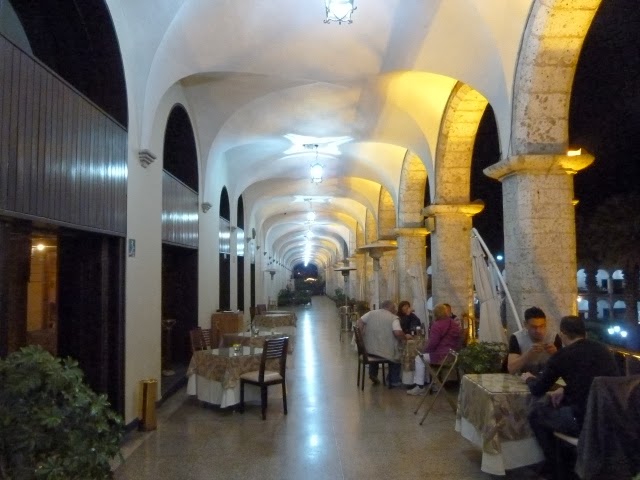
 |
| Colonnaded restaurants on the 1st floor, or 2nd floor if you are a local. |
 |
| Arequipa cathedral at night |
The city was near silver mines, which paid for the churches.....
 |
| The left tower collapsed about 10 years ago in an earthquake. |
 |
| The symmetrical main square in Arequipa |
At 7,660 feet above sea level (2,335m), the heat of the desert is mitigated, and the problems with altitude are not as severe as other Andean cities. A pleasant place to acclimatise.
 |
| Andes always looming in the background |
Within the city, is the huge convent of Santa Catalina, which, until a few years ago, had been closed to outsiders for 400 years. The nuns communicated to visitors via grilled windows at the entrance, but within the walls, ran their lives in total privacy.
 |
| Santa Catalina Convent - a town within a city. |
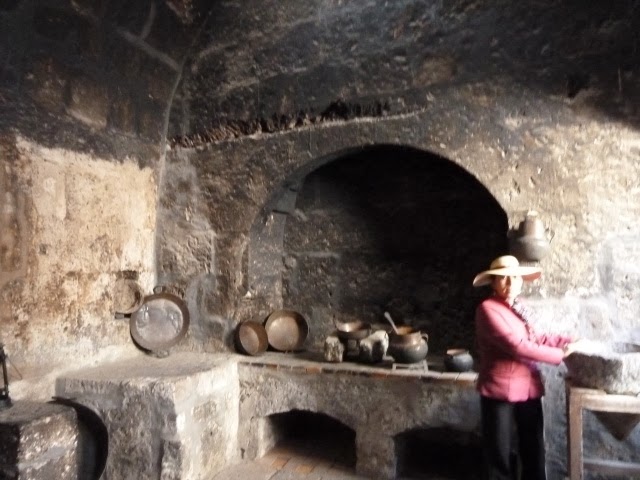
We took a tour of this fascinating enclave, and it was like stepping into medieval Andalucia! Wonderful bright colours, narrow streets, ancient kitchens and washing facilities, well-tended gardens....
 |
| The convent's kitchen |
 |
| Guinea pigs would keep the floor clean, and be a convenient source of protein.... |
 |
| Calle Cordoba, St Catalina Convent |
The prospective nuns would come from wealthy Spanish families and would either stay there for life, or leave after a few years as a novice.
Tourists now roam the streets where, for centuries, only nuns were allowed.
 |
| Calle Granada |
From a rooftop, one could look over the high walls surrounding the convent, to the mountains surrounding Arequipa.
 |
| ChanChani volcano |
A few minutes walk away, one could be back in the 21st century and the delights of of the Plaza de Armas.
 |
| Arequipa breakfast spot |
B is for Ballestas Islands ............................................................................................................
These islands are a few miles off the coast of Peru (near Pisco!), and famous for their wildlife.
On the way, we passed the huge "Candelabra" sculpture in the desert. A sign for sailors? Designed by aliens from another planet? It's about 150 metres tall, and points due south!
The islands used to be rich in Guano, which provided the newly-independent Peru with a huge income in the 19th century as Europe demanded fertiliser for its growing populations.
Now the islands are a Nature Reserve. As we approached, we could hear, see and smell the thousands of seabirds......
Mining the guano was hard work, and it only stopped when chemists discovered how to make artificial fertiliser.
 |
| Every available surface is taken by sea lions, penguins or seabirds..... |
C is for.....
Condor - didn't see any, sorry!
C is also for Colca Canyon.............................................................................................
This is a deep, remote valley, about twice as deep as the Grand Canyon in Arizona.
 |
| Ancient terraces increase the available land. |
 |
| A local lady of Colca Canyon. Hat embroidery indicates family, marital status, skill, worth, wealth, .... |
C is for Cross Keys - an English pub at 11,000 feet. (see "X Keys")
D is for DESERT .................................................................................................................
Most of the country between the Pacific Ocean and the Andes is desert, with occasional irrigated river valleys, providing a sudden belt of greenery. Many grapevines are grown, as well as asparagus and artichokes and other high-value vegetables.
 |
| The Dakar Rally comes through here in January! |
 |
| Irrigation allows crops in the desert. |
 |
| Good harbours are few and far between..... |
 |
| An unstable shore, prone to earthquakes. |
Desert dwellings
The biggest surprise for me was that many people live in shacks in the desert, far from any town. Not only is it free, but it means they may be able to find work in a Natural Gas plant. Peru is an oil and gas exporter!
E is for Earthquake ......................................................................................................
 |
| Our 2-storey hotel had a lift - which we didn't use...... |
Peru is prone to earthquakes, and October is supposedly earthquake month! Luckily, we didn't feel the earth move. But we walked up the stairs, just in case.....
F is for Floating Islands .....................................................................................
On Lake Titicaca, a tribe of people, the Uros, still live on reed islands, which float in the shallow inshore waters.
The moved onto them several centuries ago to escape the ravages of aggressive neighbours such as the Incas.
They now rely on tourism for an income, and some villages are a popular trip from the nearby city of Puno. But others do not accept any visitors. Some villagers are wary of outsiders and officialdom, and traditionally they don't pay tax. However, they don't have electricity, running water or roads! A little inshore tax haven!
 |
| A quick demonstration on how to build a floating island. |
 |
| Cooking is done carefully..... |
 |
| Differently-coloured hair braids indicate marital status. |
 |
| The whole island turned out to wave goodbye.... |
 |
| About 2,000 people live on about 100 islands |
F is also for Food! ..............................................................................................
 |
| Avocado and poached eggs for breakfast |
It was fabulous. See "Guinea Pig" (I'm joking!)
 |
| Probably the best airline meal I've had..... |
G is for.... Guinea Pig. Photo not suitable for younger readers.......
H is for HUMMING BIRDS! ...........................................................................
 |
| My first sightings. And unexpected at 11,000 feet. |
and HOT SPRINGS.........................................................................................
 |
| Being a volcanic region, there are lots of thermal springs...... |
J is for JELLYFISH! .........................................................................................
In Paracas, the beach was littered with hundreds of huge jellyfish. So - no swimming in the Pacific Ocean.
Ooops. I missed out "I is for Incas"! I'll post these later when I've overcome a limitation on the number of photos per blog!
Peter