[This is an occasional look at life in the South Atlantic, usually on the Falkland Islands. However, this month, we ventured much further south, to the Great White Continent....Antarctica! This is long, so I've split it into sections -
# Getting there;
# Stunning Scenery;
# When you are in a hole - stop digging!;
# "Thar she blows!";
# Deceptive Deception;
# In Shackleton's Footsteps;
# Birds, birds, birds.]
GETTING THERE......
A long, long time ago, in a galaxy not far away, my wife and I attended a Charity Ball in aid of Falklands Conservation (
http://www.falklandsconservation.com/ ). The top prize in the auction was a trip to Antarctica!
 |
| Checkin on Antarctic Airways, Punta Arenas. |
Having over-indulged in the excellent wine, I was first to bid in the Dutch auction (where the auctioneer lowers the price until someone bids). The trip was ours! The company donating the prize informed us we could go on any of their voyages to Antarctica, as long as the journey started or finished in the Falklands, which was fine by us!
 |
| British Aerospace 146 |
After 18 months of anticipation, we eventually boarded the regular, weekly flight from the Falklands to Punta Arenas, Chile. For a change, we weren't passing through, and enjoyed exploring the remote city at the southern tip of mainland South America. Then the day loomed. Checkin at the airport for the 2 hour flight to a Chilean base in Antarctica, where we would join the ship! (I think I am going to wear out the exclamation key!!)
 |
| Brazilian transport plane that didn't make the runway.... |
After an uneventful flight (which saved us two days of sailing across the notorious Drake Passage), my initial impressions of the "airport" on King George Island were somewhat mixed. The air was cold. The snow was piled high. The runway was very rough gravel, reminiscent of the roads on the Falklands. The only building in sight was a control tower 400 metres away. Waiting on the apron, I recognised a Brazilian Air Force transport plane that had famously not quite managed to land on the runway and was now sitting forlornly, engine-less, on the apron. (I had made the mistake of earlier researching the base and discovered it had the lowest success rate for landings, anywhere! I didn't share this knowledge with my fellow-passengers!)
 |
| King George Island arrivals lounge |
So, we had arrived in Antarctica. What now? Where was the welcome? The crew? The ship? Our luggage? :-)
 |
| Glad I brought my FIGAS hoodie. It's a bit nippy! |
We were later to discover that the logistics of accommodating tourists on a remote scientific base could be challenging. But some people climbed into a waiting helicopter and took off on their adventure......
 |
| The shuttle to the private yacht |
The rest of us milled around and stamped our feet, the novelty of the cold air and frozen ground beginning to wear off. We had expected warm jackets and trousers to be provided on arrival, and I had only a light rain jacket on.
 |
| Firstly, find some warm clothes..... |
Soon, though, a pickup truck arrived with crates containing warm jackets, salopettes and rubber boots.
 |
| Secondly, carry your bags along the runway... |
Apparently, the ship was in the bay, about a kilometre away. Ground transport was not available, so everyone had to pick up their rolling luggage and walk along the runway to the far side of the island. I felt smug that I had worn my own hiking boots on the flight and had a backpack for luggage.
 |
| Almost everywhere is North. |
En route, we passed the departing passengers and met more of our expedition team.
 |
| Local transport was not taking passengers. |
To be fair, it was all part of the adventure, and it was very interesting walking through the base. Much more interesting than being bussed to some soul-less airport or mundane port. Next door to the Chilean base was the Russian "Bellinghausen" base, with its Russian Orthodox church high on the hill, And the "Great Wall" was a neighbouring Chinese scientific base, not a takeaway restaurant as some hoped.....
 |
| The yacht Vava hiding our ship. |
After about 20 minutes, we arrived at the beach, where some zodiacs and penguins were waiting!
Also in the harbour were some yachts. Two were the traditional sailing yachts, but one was a super luxury floating resort, and was where the passengers on the helicopter had gone. Apparently, they were here for a spot of heli-skiing, on some virgin Antarctic mountains. Spookily, the yacht, Vava, arrived in Stanley Harbour 3 weeks later for a short visit.
 |
| Russian Orthodox Church. Not what we expected to see..... |
 |
| Chilean base |
 |
| Post Office |
Chile has created a small town, and families lived all year round there. There was a school, a post office, and scientists from the other bases frequently paid social visits.
 |
| Vava - not our ship |
On the beach, we donned waiting life preservers and were briefed on how to board a zodiac, how to sit in it, how to stand in it to take photos and what to do if someone fell overboard into the freezing water... ......The expedition team - naturalists, zoologists, ornithologists, kayakers, etc, wore orange hats. We listened to them......
An exciting first hour in Antarctica. Just another 288 hours to go!
================================================================
STUNNING SCENERY.....
 |
| Breathtaking. |
Soon, we were on the ship, our home for 12 days, the Akademik Sergey Vavilov - a former Soviet research ship, built for stealth and polar waters. Extremely quiet, stable and manoeuvrable! It was registered in Kaliningrad. The crew of 40 were Russian. The company leasing it, One Ocean Expeditions, was Canadian, and most of the expedition team were Canadian, with a smattering of Australians, Brits, Japanese and Chinese. All were multi-talented as we were to discover later.
 |
| Seabourn Quest |
I later found out the chefs were the only crew members who weren't Russian - they were Argentine. The food was delicious - some of it no doubt sourced in the Falklands! There were 80 passengers, and we all ate at one sitting in the dining room, sitting wherever we wished, making new friends and discussing the day's sightings.
 |
| Paradise Harbour around midnight, December 30th |
As we sailed south, the weather was amazing. Flat calm for 3 days, with brilliant sunshine for about 22 hours of the day. It didn't get fully dark, and it was disorientating waking up during the night and watching icebergs with penguins on them floating by....
 |
| Pretty iceberg |
In 2011, my wife and I had been lucky enough to travel to the region, and we knew this weather would probably not last. But it was wonderful to experience the grandeur of Antarctica in such circumstances. The air temperature was around 0 Centigrade.
 |
| Iceberg |
Our journey continued, past innumerable icebergs and glaciers. Every iceberg was different. Some new, some old, some spectacular, some vast, some sculpted by the waves.
 |
| Whale iceberg |
As evening approached, we could stand on deck for hours watching humpback whales feeding on krill.
 |
| Wilhemina Bay |
The landscapes were amazing - like another planet. It was difficult to get a sense of scale, until a familiar sight of another cruise ship hove into view.
 |
| Zaandam, a familiar sight in Stanley |
However, these large ships cannot land passengers in Antarctica. The rules don't allow more than 100 people to go ashore at once. And a ship with over 500 passengers can't let any passengers ashore. I don't know how much the Zaandam passengers enjoyed their trip, but someone once likened it to travelling across the globe to the best restaurant in the world, reading the menu outside and looking in at the diners........ then leaving!
==============================================================
WHEN YOU ARE IN A HOLE - STOP DIGGING!
 |
| Digging parties preparing the ground |
We had only 80 passengers, so we could all go ashore at the same time. Some of us even took up the offer of camping ashore!
 |
| Hole with a view |
One of the many highlights on the trip was the option, weather permitting as always, of spending a night on the continent of Antarctica. I admit I initially thought the expensive cabin on the ship would be a better bedroom, but I was persuaded otherwise by the more adventurous member of the marriage......
 |
| Portal / Reclus Point |
So, with the weather calm, the lucky volunteers were transported ashore and issued with a bivvy bag, and thermarest mattress and a sleeping bag. Oh, and a shovel. I had had visions of the expedition team erecting tents for us, but most of the team were busy organising the New Year's Eve party on the ship....
 |
| Snow holes ready for inspection... |
We were advised to dig a hole in which to place all the bedding, so that if the wind picked up during the night, we wouldn't be hit directly by it. I'm not sure what would have happened if it had snowed overnight!
 |
| Snug, with penguin |
The guides did erect one tent. It contained a barrel, and this was our toilet. Nothing was to be left on Antarctica. No litter. No waste. No yellow snow....Despite the advice about not drinking too much, I couldn't resist a wee whisky from a flask. It was Hogmanay, after all.
 |
| Possibly the first Rockhopper penguins on Antarctic mainland, and the most southerly copy of Penguin News. |
The place was really special for us, as it was where the Reclus Hut had been. This had housed a British expedition in the 1950's and the hut is now ensconced in the Historic Dockyard Museum in Stanley. We have seen it many times, and had always wondered what it must have been like to live in it. Now we have an idea. I'm so glad I took my wife's advice....
https://www.bas.ac.uk/about/antarctica/environmental-protection/special-areas-and-historic-sites-of-antarctica/reclus-hut-port-stanley/
==========================================================
"THAR SHE BLOWS!"
One type of wildlife sighting always gives a thrill - Whales!
 |
| Near Elephant Island. View from the bridge. |
 |
| Humpback diving |
 |
| Humpback, from a zodiac! |
We saw plenty - mostly Humpbacks, but also Fin and Killer. Maybe other species, too, but some were too far away to clearly identify. Some were miles away, whilst on one occasion the pod was so close to the ship, the guides were shouting at people out on deck to "Look Down!", instead of peering out to sea.
 |
| A fluke, honest! |
We saw them feeding, which entailed swallowing huge amounts of water, then expelling it but retaining the krill. This is where having specialists on board to explain the behaviour really helps. And, in time, the novice can start to predict, say, when a dive is about to happen and have the camera ready!
 |
| Krill trawler and krill-eating whale, blowing. Co-exist? |
I was a bit concerned at a number of fishing vessels in Antarctica. I was told they were extracting krill, But it wasn't clear the impact this would have on whales feeding in the same waters.
 |
| Climbing Danco Island to see the penguins at the top |
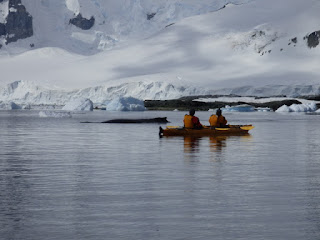
Whilst climbing a hill on Danco island, I decided the snow was too soft for comfort and headed for the beach for a zodiac cruise around the icebergs. Pretty dull, eh? We followed some kayakers from the ship for about 15 minutes and watched while whales surfaced just metres from the kayaks.
 |
| First encounter with whales. |
I'm not sure I would have liked to have been in a kayak on this occasion....
 |
| Whale and kayakers |
But I've seen the video taken by the kayaker on the left in the above photo. That whale is BIG!
 |
| "Adios" |
======================================================================
DECEPTIVE DECEPTION.
 |
| Entrance to volcanic harbour, Deception Island |
Another amazing highlight was the day at Deception Island. An active volcano, with a flooded caldera, it made a very sheltered haven for the early whalers, and, later, scientists from the Falkland Islands Dependencies Survey, which later transformed into the British Antarctic Survey (BAS).
 |
| Whaling industry remnants, Deception Island |
It was abandoned about 50 years ago, after several eruptions and landslides damaged many buildings.
The whalers had long gone, but not before killing about 2 million whales from the southern oceans, over about 50 years. Just think how different the seas would be now if there were 2 million more whales in them!
 |
| Calm kayaking |
We had passed Deception soon after landing at King George Island. But it had been late at night and we needed to get further south. This had been the third time my wife and I had sailed past the island and we were pessimistic of ever getting the chance to see it. The weather in Antarctica is too unpredictable to make concrete plans.
 |
| Whale oil tanks |
However, we were delighted when Nate, our excellent Expedition Leader (EL) announced one day that we would be trying to enter this almost mythical location when we turned north.
 |
| Norwegian grave |
After the ship had squeezed through the narrow entrance known as Neptune's Bellows, we were quickly ashore in the sheltered harbour. The ship's historian, Chris, gave a great walk and talk through the sites, explaining the fascinating history of the place, and the huge scale of the whaling operation.
 |
| Abandoned buildings |
The main occupied area was about a mile long, with accommodation buildings, storehouses, hangars (there used to be flights from an airstrip there), as well as the massive tanks for steaming whale blubber and storing the oil.
 |
| "Biscoe" is a famous name in the Antarctic. There is even a street named after him in Stanley. |
Despite the cold, I was reminded of a "ghost" town we had visited years ago in Namibia. An old diamond mining town called Kolmanskop which had been abandoned in the desert when the diamonds ran out. The sand dunes were reclaiming the town. Now the whale population had been decimated, the snow was occupying the buildings here.
 |
| The snow reclaiming old buildings |
 |
| Boilers |
However, it wasn't all doom and gloom. The volcanic activity slightly heated the water, so that it was possible to swim in the sea here. Volunteers were sought for the Polar Plunge and, being a veteran of several South Atlantic Midwinter Swims in the Falklands I felt it would be a mistake to miss this opportunity.
 |
| Relaxing after the swim. |
About 20 mad people stripped off on the beach and walked gingerly into the water. And it was warmer than the Falklands, although most of the spectators had 5 layers of clothes on.
 |
| A lot warmer than the Midwinter Dip in the Falklands! |
The main problem with these events is getting warm afterwards, but some people took advantage of the hot tub on the top deck and and enjoyed a relaxing soak as the ship squeezed out through Neptune's Bellows again.
 |
| Relaxing in Antarctica, Deception Island |
I must try and get the organisers of the Falklands Midwinter Swim to install a hot tub.....!
|
|
| No risk of hypothermia here.... |
==============================================================
IN SHACKLETON'S FOOTSTEPS
 |
| Leaning on a replica of the James Caird in Punta Arenas. (Le Boreal cruise ship in the distance.) |
I should say that we also absorbed a lot about Sir Ernest Shackleton on the trip. Not only did we have some great talks from Chris, the Historian, but we also visited a few places that Shackleton and his men had been on their ill-fated voyage between 1914 and 1916.
 |
| Fleeting glimpse of a Wandering Albatross |
Time and space does not permit me to repeat the amazing feats of exploration, navigation and survival that epitomised Shackleton's Trans-Antarctic Expedition of 1914 on the "Endurance".
 |
| Elephant Island - the beach where the Endurance crew survived for 4 months. |
But, if anyone is in Punta Arenas, they can see a replica (above) of the Endurance's lifeboat, the "James Caird", which was used by Shackleton to sail from Elephant Island, (where most of the men were to await rescue), to South Georgia, 800 miles away across the world's roughest seas. An unparalleled feat of navigation.
 |
| Elephant Island |
 |
| Lone chinstrap on Elephant Island |
Also in Punta Arenas is the Shackleton Bar in the Hotel Jose Nogueira! His epic story is described in paintings on the wall.
The bar is certainly a lot, lot more comfortable than Elephant Island. We didn't land there, but were literally within touching distance. It is mostly rock and ice. Shackleton's men waited there for 4 months, living on penguins until rescue came, thanks to the Chilean Captain, Luis Pardo, on the tug, Yelcho!
https://en.wikipedia.org/wiki/Yelcho_(1906)
 |
| Crossing the Drake Passage. Heading north. |
===============================================================
BIRDS, BIRDS, BIRDS!
 |
| Antarctic Shags, Port Lockroy |
The seas around Antarctica are so rich in life, they support a vast web of birds, fish and mammals. And, as it doesn't get dark in the Antarctic summer, birds can feed almost 24 hours a day. What better place to rear your young?
 |
| Antarctica Shag feeding chick, Port Lockroy |
Huge colonies of penguins - Chinstrap, Adelie, and Gentoo, (with King and Macaroni around South Georgia Island) - vie with similar numbers of shags, petrels and albatrosses, although the latter tend to breed in the Falklands and South Georgia and "commute" to the fishing grounds around Antarctica).
 |
| Chinstrap penguins, and Macaronis, Elephant Island.. |
 |
| Chinstrap and Macaroni penguin lookouts, Elephant Island |
Islands like Elephant and South Georgia are heavily glaciated, but adjacent to great feeding grounds.
 |
| Chinstrap chick |
 |
| Newly-hatched Gentoo chicks, Danco Island |
We were lucky enough to time our visit as many penguin chicks were pecking their way out of their shells. Parents were busy fishing and then regurgitating the nutritious catch for their offspring.
 |
| Chinstrap and chick, Half Moon island. |
However, predators such as Skuas had young to feed, too, and penguin chicks were an easy prey for them.
 |
| Adelie penguin feeding chick, Brown Bluff, Antarctica. |
 |
| Adelie penguins on an ice floe, Brown Bluff |
When chicks were large enough to be left alone for a few hours, they would huddle together in "creches" for protection from predators. When the parents returned, they would call to their chicks and recognise the answering call. No point in feeding someone else's chick!
 |
| Macaroni! |
 |
| South Polar Skua - no bird breeds further south. |
 |
| Crossing the Drake Passage - no smoothies in the bar today due to the, er, swell..... |
 |
| Southern Giant Petrel, possibly raising a chick in the Falklands. |
One morning, we emerged onto a sunlit deck and a warm breeze in the air. We had crossed out of the Antarctic Ocean into the South Atlantic. No more icebergs or freezing temperatures.
 |
| Yet another Southern Giant Petrel.... |
What we did have was a mesmerising procession of petrels and albatrosses following, and overtaking, the ship. At times, they would fly effortlessly alongside the ship at eye level, so even a novice could take good photos of them. I could watch them for hours.
 |
| You don't need to be a weatherman to know which way the wind blows.....West Point Island, Falklands |
Also onboard were two professional photographers, whose remit included helping the passengers get the most out of their camera. Various workshops were run and critical, but friendly, eyes were cast over photos, with a view to helping the photographer to improve. One of the photographers, Boomer, is on the left, above, trying to see some sealions spotted by the ornithologist, Simon, on the right. This was our first sight of the Falklands, but the weather was so squally, we couldn't go ashore at West Point Island......
 |
| No landing, but we still see penguins! |
Sensing the deep disappointment of the passengers, the Concierge team organised a Hula Hoop session...in penguin costumes! Like the other entertainments devised for passengers, this was highly popular and entertaining. (The "Fireside chats" in the bar after dinner, were a fantastic opportunity to hear others' experiences, or listen to great live music. On numerous occasions, the Concierge and Expedition teams went "the extra mile").
 |
| Sea Cabbage on Saunders Island |
We sailed north and east to Saunders Island, another gem in the crown of Falkland Islands. However, the wind didn't seem to be easing and we waited offshore for 2 hours gazing at the island - our last wildlife destination of the trip, and the last opportunity to see penguins!
 |
| Expedition team struggling against the elements, Saunders Island |
Eventually, our intrepid Expedition Leader decided to risk a bumpy zodiac ride and got us all ashore safely to see the various birds - black-browed albatrosses, four species of penguin - Rockhopper, Magellanic, Gentoo and King. It was worth getting wet.
 |
| King! On Saunders Island, Falklands |
 |
| King Penguins with eggs, Saunders Island |
 |
| Gentoo colony, Saunders Island |
 |
| The Neck, Saunders Island. |
 |
| Black-Browed Albatross chick, Saunders Island, Falklands. |
 |
| Black-Browed Albatross courting behaviour. |
After the excitement of the zodiac rides and the close-quarter observation of birds that spend most of their lives at sea, there was one more highlight. We were invited to sit at the Captain's table for dinner!! Luckily, my wife had attended Russian classes in the past and knew a few phrases with which to break the ice. "More borscht, Captain?". "Niet!". Seriously, it was a great honour, and allowed us to personally thank the Captain for providing such a unique experience. On one memorable occasion, he turned the ship around in its own length to follow a pod of Orcas.
 |
| Following an oil rig supply ship through the Narrows, Stanley harbour. Home is within sight.. |
Much of the rest of the evening was a blur, but I woke to see my first familiar sight for 2 weeks - Stanley Harbour. We sailed carefully through the Narrows behind an oil supply vessel, and then turned the bow to face the westerly breeze and edged slowly towards the jetty known as FIPASS (Falklands Interim Port And Storage System).
 |
| "Haste Ye Back!" |
As ropes were attached to bollards, familiar faces looked up at us from the jetty. We were home! But we would never forget an amazing trip. Our enormous thanks are due to the Captain, crew and expedition team on the Vavilov, and One Ocean Expeditions who enabled us to travel safely and comfortably to such a wonderful wilderness. We are privileged.
 |
| Giant Iceberg and Southern Giant Petrel |
But our experiences would not have been as rich without our fellow passengers, who contributed so much in so many ways. Who would have thought, for example, that I would listen enthralled to a recitation of "The Cremation of Sam McGee" in the bar? Not me! If you read this, I hope you guys enjoyed it as much as we did, even though you all had much longer journeys home!!!
Go Well! Stay Well!
Peter, and Annie xx