Friday, 21 June 2013

Liberation Day; Booming Economy; and more Rambling..

[An intermittent and personal report on life in the Falkland Islands...... This week, a stroll in the country, Liberation Day, and a booming economy.......]
Turkey vultures in town
It's now midwinter in the Southern Hemisphere.  It's snowing today, but the good news is that the days will start to get longer.  The horses have been moved to their winter grazing grounds on Stanley Common, and the vultures are moving into town, as food gets scarcer.
Snow Ghost and friends
Stanley Common  is a large open area, near the local airport, and horse-owners can graze their horses there during the winter for a nominal sum.  However, it seems that some oil drums (with oil still in them), have been dumped near the common, and this has leaked.  Investigations and clean-ups are still ongoing, but it shows that managing waste on an island, even one with as much space as this  one, can be problematical.
View across Stanley harbour.  A new port site?
If "ordinary" waste such as plastic bags and sewage are not handled well now, then there could be issues when the oil industry arrives in force with more complex challenges.  However, I suspect the oil industry is used to working in strictly controlled environments.  In fact, I know that otters are thriving around oil installations on Shetland, in the north of Scotland.
Housing boom/
Signs of  a booming economy are beginning to appear in the town of Stanley.  Houses seem to be popping up in every available spot.  "Infilling" the traditional, large gardens is a solution for the lack of space in the centre of town.   However, it is not to everyone's liking, and there is much talk about preserving the Falklands' way of life, as inevitable changes appear on the horizon.

Another sign of a healthy economy -  a recent Government budget announced a 5% pay rise for all Government employees!  And in a recent Penguin News, there were 2 pages advertising various vacancies -

Trainers (for Carpentry, Languages, IT, Hospitality),
Handymen
Legislative Drafter
Regulator
Waitresses/bar staff
Electricians
Storemen
Cleaners
Operations Managers
Nursery Nurses....
~~~~~~~~~~~~~~~~~~~~~~~~~~~~~~~~~~~~~~~~~~~~~~~~~~~~~~~~~~
Featureless grasslands need good navigation skills.....
As an antidote to the town, I often try to join walkers in exploring less-visited parts of East Falklands.  These walks are often on some of the huge farms, and prior permission is always sought from the landowner.  One farm I recently visited was 45,000 acres, which turned out to be much the same size as Liechtenstein, or bigger than the Channel Island of Jersey!.
White grass underfoot
So, it usually helps to go with someone with local knowledge or a good map and a GPS!  Much of the landscape can appear featureless, so navigation is often an issue.   However, on this walk we were largely following a river valley.  The main problem was the uneven white grass underfoot.   It's impossible to relax and look around, without risking putting your foot in a hole, or stepping on an ankle-turning tussock.
Cloud cover on the high hills.
Even so, some of us diverted to a ridge with panoramic views, while others stayed on the riverbanks
Whichever route was chosen, it was hard going.  At the end, my pedometer showed 5 miles, while it felt more like 15!  There are no paths to follow, and often it seems as if no-one has ever walked there before.
Nearing the finish.....
However, despite the effort, it was an enjoyable couple of hours, culminating in great sightings of the Variable Hawk.  Several of these beautiful birds were soaring above a cliff on the opposite side of the river.
A Grand Day Out!
~~~~~~~~~~~~~~~~~~~~~~~~~~~~~~~~~~~~~~~~~~~~~~~~~~~~~~~~
"Eyes.........right"
On June 14th, a large crowd gathered at the Liberation monument in Stanley,  to commemorate those men who gave their lives in liberating the Falklands 31 years ago.  Unlike the same day last year, the weather was benign, and despite the sombre aspects of the service, the sunshine lifted the spirits of the spectators.
A full set......
After the service and march-past by troops of the British Army, Navy, and Air Force, and the Falklands Islands Defence Force, everyone (yes, everyone!) was invited to a reception in the Town Hall.   This enabled locals and visitors to mingle with the troops, past and present, and chat about their experiences over a beer and some nibbles.
Mt William
Afterwards, it seemed a shame to be indoors on such a fine day, and a Public Holiday.  So, my wife and I drove a few miles out of Stanley and explored a hill called Mount Harriet, where there are still a number of graphic reminders of the battle that was fought there.  
An old Argentine machine-gun position, looking towards Mt Tumbledown.
Few of the British troops that liberated the Falklands would have enjoyed this view, as all the fighting was at night, and they were under severe shelling from Argentine guns during the day.  However, because of their actions and sacrifices, we, and others, can enjoy it now....

Peter

Thursday, 13 June 2013

HMS Glamorgan remembered.

This is an on occasional report on life on the Falkland Islands.  This week has seen several memorial services for the men killed in action 31 years ago during the Falklands War.  On a very cold and windy day, I attended a service for the men of HMS Glamorgan.
~~~~~~~~~~~~~~~~~~~~~~~~~~~~~~~~~~~~~~~~~~~~~~~~~~~~~~~~~~
Two Sisters
Thirty-one years ago, on the 12 June of June 1982, the British forces attacked several strongholds of the Argentine invaders, in the hills to the west of Stanley. (I was going to apologise if I'd mentioned this before, but, thinking about it, these sort of events where many men sacrificed their lives, do bear repeating. They should not be forgotten. So no apologies.)
The TV crew await the start of the service
Three hills were the main targets that night, and Two Sisters mountain was at the centre of the frontal assault on the entrenched Argentine troops. The men of 45 Commando had an unenviable task of winkling out Argentine soldiers in their foxholes and fortified positions. In order to reduce the casualty rate, as the soldiers walked towards the enemy, all attacks were done at night.
The service
As I had found out on a recent Ramblers walk, even the most benign-looking landscape in the Falklands can be a struggle to walk across, and navigation is tricky.  At night, it must take exceptional fitness and skill (and courage, as minefields were all around in 1982).

In the end, some troops were delayed getting into position for the attack, and the decision was made to delay the start. This had the knock-on effect of keeping HMS Glamorgan, which was providing covering artillery support,  off-shore for longer than planned.
Laying of wreaths
As the battles and night wore on, rather than retire from the battle at the planned time, HMS Glamorgan stayed and fired hundreds of shells into Argentine positions. This support was crucial, and the hills were eventually taken after fierce fighting.
But Glamorgan now had to run the gauntlet of a land-based Exocet missile launcher, stationed at Surf Bay, to the east of Stanley.
Sleet showers to the east.
In order to regain the safety of the fleet before sunrise, Glamorgan “cut the corner” and strayed within 20 miles of the Falklands' coast. The Exocet was launched, but was tracked by the crew on Glamorgan.  Given the recent sinkings of British ships by Exocets, the captain decided to turn the ship at an acute angle to the incoming missile and this did prevent the ship from being holed.

However, the missile still exploded and also caused an onboard helicopter to explode.  The ship was damaged, but it stayed afloat to fight again.  The first to survive an Exocet hit.
"They shall not grow old...."
Fourteen men were killed in the fires, and yesterday former comrades, current military representatives and Islanders turned out on Wednesday to remember their sacrifice.

Two days after the attack on Two Sisters, the Argentine troops surrendered.  Liberation Day, June 14th,  is a special day on the Falklands.
They shall grow not old, as we that are left grow old:
Age shall not weary them, nor the years condemn.
At the going down of the sun and in the morning,
We will remember them.

We will remember them.


Peter

Tuesday, 4 June 2013

"Dear Warden of the Penguin Resort, Falkland Islands"

[This is an occasional insight into a life in the Falkland Islands from the view of an expat living here for a few years.   After a recent foray "Up North" to the UK, life is settling into a routine with the onset of winter.....]
Damp horses on winter grazing.

After our hectic trip to the UK in April and May, it's been back to a more sedate pace of life in Stanley.  For some, it means going to work and returning home, in the dark.  For others, it means taking your horses to common grazing land outside Stanley.

Winter Dawn
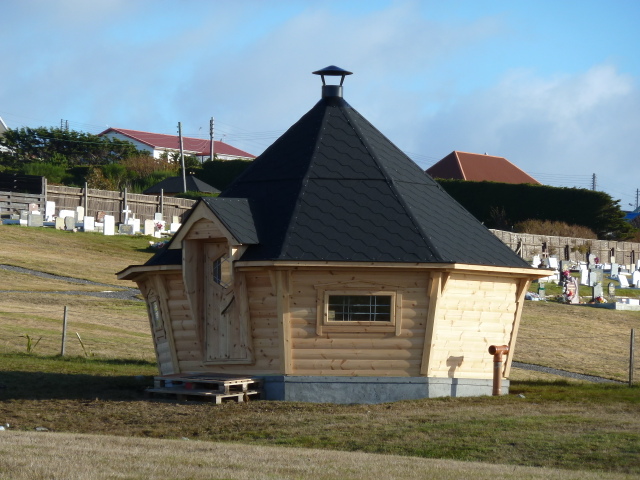
Making an appearance in Stanley are BBQ huts, advertised as a comfortable way of enjoying the outdoor BBQ experience, but without risking hypothermia while the lamb steaks cook!   I've seen similar solutions in Scandinavia where grilled elk can be enjoyed without freezing in snow.  I wonder is open-air saunas will catch on here?  Watch out for a forthcoming report on the Midwinter Dip!
"Outdoor" BBQ hut
On the wildlife front, I haven't seen any penguins in the last month, but there are still lots of native birds and animals, and even some introduced species such as hares, which you can spot while out walking.
Endemic Flightless Steamer Duck
So, with the desire for some sunshine and wildlife spotting, a few of us set off on a blustery (alright, windy) day to see what we could see......
"To the Lighthouse!"
Cape Pembroke is the most easterly point of the Falkland Island, about 7 miles east of Stanley.  The lighthouse is no longer in use, but inside are displays of how the lighthouse keepers lived, prior to 1982, when the  imminent Argentine invasion prompted the Governor to order the light be put out.  (A smaller, automatic,  light a few yards away now guides marine traffic).
View from the top.  Next land is 12,000 miles  that way.
And, even on a blustery day, it makes a wonderful walk through the sand dunes to reach this point.  Talk about "Blowing away the cobwebs"!
Into the breeze
We did see some wildlife - including a house mouse and a variable hawk (both too quick for my  camera skills).  But it was invigorating just watching the huge rollers smash into the rocks that marked the end of the Falklands.  The next land due east is the west coast of Chile, 12,700 miles distant.  So these waves had had a long time to build up their energy.
A more peaceful day.

The public jetty
Around Stanley, the winter gives an opportunity to build or rebuild public buildings which would otherwise be in use during the tourist season (November to April).
Filling in the harbour
The public jetty, where most cruise ship passengers come ashore, is to have a long-term upgrade, and this currently involves truckloads of rocks being dumped in the harbour.  But the final vision is to  have a smart development which will welcome tourist and round-the-world sailors to this safe haven.  A far cry from the "Danger: Keep Off" sign that is often the first sight visitors see!
Multi-coloured Nordic Walkers, overlooking Stanley harbour.
The photo above was taken near Gypsy Cove, where I worked during the recent tourist season as a Warden at a penguin colony.   We had thousands of visitors this year, but one lady felt moved to write and thank the team for helping to find her sunglasses.
The vultures gather on a Stanley roof.
The postcard, from Ushuaia in Tierra del Fuego, which was probably her next port of call, was addressed to -
"The Warden in Charge
Gypsy Cove Penguin Resort
Falkland Islands
Falklands"

"Dear Warden,
I sincerely appreciate the trouble you took and effort you expended in finding my sunglasses.  Thanks a lot for going the extra mile to find them, Regards,  "

How nice of her to take the trouble to write and thank us, and I just love the idea of a "Penguin Resort".   In some ways, it was a resort for the penguins who travelled south from Brazil to breed, meet up with old friends and raise a family, before heading back to warmer beaches in the Autumn.

In May, the temperature here reached a balmy 13C, but also plummeted to -2C!

If you want to visit this particular resort, the Tourist Board site is a good starting point >
http://www.falklandislands.com/

More soon,
Peter

PS.....
Banned! 
As a postscript to our UK trip, we had been asked by friends to bring back some fresh fruit, so we paid a visit to a farmers market in England.  Unfortunately, despite recent relaxations on importing fruit into the Falklands from abroad, we hadn't noticed that melons were still on the banned list!

I considered having this blog entitled "Custom Officers grab my wife's melons!", but I was told that wasn't a good idea......So, that's goodnight from me....!


Thursday, 23 May 2013

"O, to be in England, now that April's there..."

[My wife and I recently, and briefly, returned to the UK after 16 months enjoyable "exile" in the Falkland Islands, which are 400 miles east of South America; and 600 miles north of Antarctica.  Flowers, trees and song-birds are in short supply here, so it was with some anticipation we looked forward to seeing and hearing the signs of an English Spring again.  I know many readers of this blog live in the UK, but, apart from the UK and US, many readers are from Germany, Romania, the Philippines, Turkey, Pakistan and Brazil, so may not be aware of the delights of the English countryside!

As you may know, this week's title comes from Robert Browning's "Home Thoughts, from Abroad", which seemed to sum up many of the pleasures of visiting the UK in April/May.  I've reproduced it at the end of this blog.]
Falkland's escort sees us off....
In the previous blog, I described our short stay on Ascension Island en route to the UK.  After 4 days there, we boarded the next north-bound plane to RAF Brize Norton, the base from where Falkland's flights operate.  (They also fly to Camp Bastion, Afghanistan....)
Fruit & veg stall, Teddington, Richmond, Surrey.
Soon after arrival, after a relaxing 9-hour flight, we were speeding along the Oxford bypass.  Well, I felt we were speeding.  I was doing 60mph, more than I had done for 16 months on the Falklands, but everyone was overtaking me.   And unlike on the Falklands, no-one was giving a cheery wave as they passed....

A welcome sight...
But soon, we were in more familiar stomping grounds.  Since we'd left Teddington in January 2012, some new additions to the landscape, such as a fruit and vegetable stall and a gold post box, had appeared.  The fresh veg was a welcome sight, as were the prices - about 75% less than those in the Falklands!!
Gold post box, Teddington
The post box has been repainted in a tribute to local Olympic hero, Mo Farah, and even the FARA charity shop had changed its name in his honour!  Mo used to train in the local parks....
Nordic Walking at Hampton Court Palace.
As I met up with old friends, I was often asked what life was like in the Falklands, and what I missed about the UK....
Swan nesting in Bushy Park, Richmond.
Apart from friends and relatives, I knew that I missed the tree-filled parks around where I used to live.  Richmond Park is famous, but Bushy and Home Parks, adjacent to Hampton Court Palace, are also stunning.
Park parakeet - exotic resident.
So - we missed people, trees and the vast choice of restaurants!  One pub in the Cotswolds had a menu of about 20 different dishes, all with asparagus, which was in its brief season.
The asparagus season was at its height
A couple of night's stay in the Cotswold Hills reminded us of how beautiful the rolling English countryside could be....

A feature of the British countryside, that we don't enjoy in the Falklands, are the miles and miles of excellent footpaths.  Endless routes can be explored, without worrying too much about navigation skills.
New Cotswold stone wall
The Cotswolds Hills (for those of you who don't know about them) are rightly a popular walking area, with lots of "chocolate-box" villages, hills, valleys, streams, and an abundance of lovely country pubs.
Walkers meet rider and horse
The hills are made of a beautifully-coloured limestone, which makes a stunning building material.  Most of the cottages are built of Cotswold stone, which weathers to a mellow honey colour.
40-mile views to Malvern Hills and beyond.
Rising to around 1,000 feet, the hills afford views across southern England, and to Wales in places.
Apple blossom.
One aspect of a British Spring that I used to take for granted is the abundance of blossom.  We walked around orchards full of apple trees in full bloom.  I even tried a bottle of local cider...
Cotswold cottage
The village we stayed in was a typical Cotswold place - ancient cottages built when wool provided wealth for the region, but now a quiet backwater, populated by escapees from city life.
Cotswold village
Built on the side of a steep hill, our village had no through traffic, so was very quiet.  But it did have a pub on the hill which provided views across 7 counties!

Another pub we visited, this time in Yorkshire, had a Infallible Weather stone outside it.  Seems to be as reliable as most weather predictions, as far as I can see!  Boynton's Infallible Weather Stone (at the Nag's Head, North Yorkshire), viz: 

"If rock is wet - it's raining
If rock is white - it's snowing
If rock is moving - it's windy
If rock is casting a shadow - it's sunny
If rock is hard to see - it's foggy
If rock is warm - it's warm out
If rock is cold - it's cold out...!"

"Yorkshiremen are never wrong."  Hmmmm.
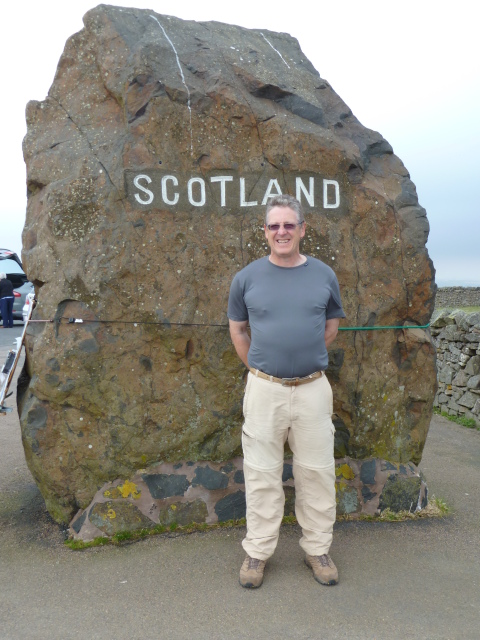
From Yorkshire, we headed north to Scotland, my birthplace, and crossed the border at Carter Bar, where a piper greets travellers!  Perhaps in years to come, border controls and passport checks will be done here.... I wonder how the referendum on Scottish independence next year will go?  There is now an added complication with the possibility of a UK referendum on whether to stay in the EU or not.
Walking onto the Arran ferry.  The gangplank was missing!
Will Scots vote to remain within the UK, and then find themselves being taken out of the EU by a majority of voters elsewhere in the UK?    Who can say?  You don't see a Referendum for years and then three come along at once (the Falkland Islands recently had one.)
Floral display in Brodick, Isle of Arran.
In Scotland, I briefly re-visited the Island of Arran - a great place for relaxing and enjoying the outdoors.  A frequent ferry service transports passengers and vehicles the 12 miles from the mainland to the capital, Brodick.
Local shop with an international outlook
Brodick is a large village, strung along a sheltered bay, and has plenty of amenities, but retains a laid-back atmosphere.  People find themselves slowing down after arrival and getting used to "Arran time".
The bank goes to its customers
Here, the bank comes to you, and honesty boxes can be found for everything from duck food to home-baking to golf courses.  You are trusted to be honest, and that reminded me a lot of the Falklands.
Hopeful duck.....
There may be other parallels with the Falklands. Many Falkland Islanders keep ducks and hens.  Perhaps visiting tourists can be persuaded to pay for duck food in Stanley?  
Catching up with  friends and relatives in the UK!
By the way, when we visited Scotland, the blossom was only beginning to emerge.  So, it seemed to be about 3-4 weeks behind its normal schedule.  I now read that the UK has had its coldest Spring for 40 years.  A number of friends commented that their recent winter seemed to last for 6 months.  They, too, had been uplifted by the arrival of Spring, in the shape of blossom!

All too soon, we were heading back to RAF Brize Norton, for the long flight south to the Falklands.  Next time, I'll report on what it's like to travel from Autumn in the southern Hemisphere, to Spring in the north, and back to Winter, in the space of four weeks!

If you live in the Northern Hemisphere, enjoy your Summer!

Peter

Home Thoughts, from Abroad

O, TO be in England
Now that April 's there,
And whoever wakes in England
Sees, some morning, unaware,
That the lowest boughs and the brushwood sheaf
Round the elm-tree bole are in tiny leaf,
While the chaffinch sings on the orchard bough
In England—now!


And after April, when May follows,
And the whitethroat builds, and all the swallows!
Hark, where my blossom'd pear-tree in the hedge
Leans to the field and scatters on the clover
Blossoms and dewdrops—at the bent spray's edge—
That 's the wise thrush; he sings each song twice over,
Lest you should think he never could recapture
The first fine careless rapture!
And though the fields look rough with hoary dew,
All will be gay when noontide wakes anew
The buttercups, the little children's dower
—Far brighter than this gaudy melon-flower!


http://www.englishverse.com/poems/home_thoughts_from_abroad

~~~~~~~~~~~~~~~~~~~~~~~~~~~~~~~~~~~~~~~~~~~~~~~