Showing posts with label ramblers. Show all posts

Wednesday, 5 November 2014

A Long Walk on Princes Street....in Darwin's and Shackleton's footsteps.

Continuing the tales from the South Atlantic.  October brought gales, fog, snow, penguins, memorable dinners, stunning walking, the return of the tourists, and much more.....!
White Horses, Long Island Farm (courtesy of wife, and landowners)
 Spring has arrived in the South Atlantic.  Lambs are being born, birds are laying eggs, the days are getting longer, penguins, seals and albatrosses are returning to breed, and the weather is gradually improving.
Black-capped night herons nesting
 October - the April of the southern hemisphere - sees winter finally relinquish its grip on the weather, with just a few snow flurries to remind us we are only 600 miles from Antarctica.
HMS Iron Duke visits Stanley
However, the Falklands are the same distance from the Equator as London, so despite the slightly cooler weather, the islands receive plenty of daylight in Summer.  This, and their remoteness, makes them ideal breeding grounds for sea-going birds and mammals of the southern ocean.
One of the first Magellanic penguins to return to their burrow and await their partner.
 Every Spring, thousands of birds, seals, etc return to the place of their birth to continue the cycle.
Outdoor exhibit at the new Museum.
On the human side of life, a new museum has opened its doors just in time for the tourist season. It covers the Natural History of the Falklands, as well as the social history of the people here.
You don't want to get this close to a live Leopard Seal! Note the 3-pronged teeth!
There are excellent exhibits of Victorian-era shops and homes; coverage of the 1982 conflict; modern life, including the Fishing and Oil industries.  There is a room set aside for Antarctic exploration, much of which used the Falklands as a supply point.   A hut, which was used by British explorers  in the 1950s, has been transported to the Museum, and offers a great insight how men survived that harsh climate for months on end.

Ramblers on the ridge.
Just as a Postscript to the Museum, a couple of recent tourists made some very blunt comments in the Visitors Book, suggesting that the Falklands belonged to Argentina.  There was also some anti-British graffiti left around Stanley at the same time, and in the same handwriting!  As these visitors had signed their names, it was quite easy to check their Facebook pages, and see them boasting of their exploits there...
Energy-sapping whitegrass
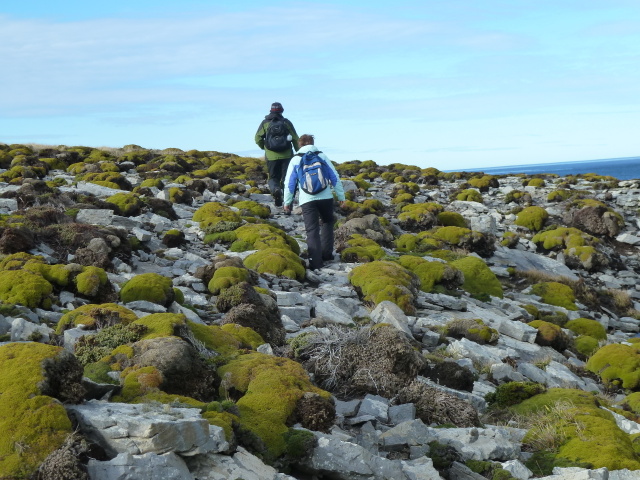
Meanwhile, the Ramblers group organised a very long and scenic walk in the hills to the west of Stanley.  Unlike most of the hills a few miles to the south, these slopes did not see any fighting or mine-laying, but they had panoramic views that made the effort of ascending them worthwhile.
Mt Vernet summit
On a very cold Sunday, a group of us set out from near Estancia Farm, while another group took some cars to the end of the walk at Long Island Farm, where we would all meet up 4 hours later.
Watching for stragglers
We estimated the walk was about 12kms (8 miles), which may not sound massive, but the ground underfoot had no paths, and was either ankle-twisting swards of white grass, or very tiring boulder fields, known as Stone Runs or "Rivers of Stone", as Charles Darwin described them when visiting on the Beagle's voyage, which would later make him famous.
Stone runs are unique obstacles.
These Stone Rivers are formed by repetitive freezing and thawing over millennia, and are not found anywhere else, I believe.  The one we crossed is also the longest, and known as Princes Street, after the long, broad thoroughfare in Edinburgh.  By coincidence, I was to fly over Princes Street a few weeks later.  More of that flight soon....  A lovely, if tiring, walk!
Princes Street (grey)  from the air.
Also in October, saw the rescue of several oiled King Penguins.  These were being looked after by Falklands Conservation near where we live in Stanley, and volunteers were sought to help with the feeding of the birds.   After a few weeks, the birds are released back into the sea, and hopefully swim back to the beaches before the tourists arrive in numbers!
Feeding time for oiled King Penguins 
 I mentioned at the start that there were some memorable dinners in October.  On Trafalgar Day (October 21), I had the privilege of dining with the Commanding Officer, British Forces, South Atlantic Islands.  He is in charge of all the troops  based in the Falklands in order to defend the islands.  A fascinating evening, but sadly, no photos.


 Like London buses, a second unusual dinner invitation came along that week.  This time as guest of His Excellency, The Governor, who hosted a dinner at Government House.  We had a short tour of the historic building, with its conservatory housing the most southerly grapevine in the world!
Signing the underside of the table is a popular tradition...
But, for some guests, the highlight of the tour was the snooker table on which explorer Sir Ernest Shackleton played whilst trying to organise a rescue for his men stranded on Elephant Island.  A few enthusiastic people felt the need to examine the underside of the table where thousands of visitors, including the Duke of Edinburgh, Prince Andrew and many others,  had left their messages for posterity.

A memorable evening in a memorable week!

Peter

Tuesday, 16 September 2014

Local activities

Back in the Falkland Islands after our recent travels to the UK and South America, my wife and I are settling into the more mundane, but still enjoyable, aspects of life here.

Ramblers / rock climbers. Mts William and Tumbledown in the distance.
September has seen a lot of rain - the most in the month for 25 years - so it was uplifting to be able to walk in the sunshine on Sunday.  The local Ramblers group set off from Stanley about 9.30, and reached the parking spot about 10 minutes later!
Lunch on the beach
Although very close to Stanley, this is relatively quiet area, due, possibly, to presence of minefields.  These lethal legacies of the 1982 war with Argentina are gradually being removed.  The government has just announce a new £2,000,000 programme, funded by the UK Foreign Office, which should remove another 4 minefields, and open up more land for more productive use.  In any case, we had a very enjoyable ramble, and watched dolphins just a few yards from the beach.
Intricate craftwork
For those who prefer indoor activities, there is a thriving and talented group of people who continue traditional crafts such as, knitting, spinning, weaving, felting, quilting, sewing, embroidery, etc, etc.  The annual Craft Fair exhibiting their creations was held in the Community School at the weekend.  Photos cannot do justice to the skill and patience involved in producing these practical works of art.
Felt penguins
As well as woollen products, there are categories for painting, photography (believe me, the standard is high!), miniature models, and even works made from from sea-shells or driftwood.  All very impressive, and a good way to keep busy when the Winter nights are long and there's no cinema!

We now await the Spring when lambing will begin, and thousands of wild birds and mammals return from the sea to breed on the islands.

I hear the first Elephant Seal pup of the year has been born on Sealion Island.  I'm going there at the weekend and will report back soon.

http://www.sealionisland.com/

Peter

Wednesday, 14 August 2013

Port Harriet Ramble

[Continuing the everyday ramblings of a Falkland Islands' visitor/resident.  Away from work, my wife and I really enjoy exploring the Falklands' countryside.....]
Belted Galloway - a hardy Scottish breed - observes the Ramblers.
 Last Sunday brought clear, blue skies, and a touch of frost.  Perfect winter walking weather.  About 20 Ramblers headed out of Stanley in a small convoy of cars, some of which parked at the walk's finish, while the rest carried on about another 5 miles.
 We had agreement from the landowner to walk around the Port Harriet farm, and set off downhill from our cars, across moorland, 3 miles to the coast.  For the main part, we followed a bubbling stream, which sometimes spread out to form bog, and at other points, squeezed between rocky outcrops.
Either climb or squeeze through small gap.
 At one such outcrop, we explored a small cave, which, in another continent, in another time, may have been home for a family.  But the Falkland Islands have been "adrift" in the South Atlantic for about 400 million years, and so there is no sign that Man has ever been here.

A sea inlet
Once we had negotiated this cliff, and repaired heads that had clashed with the rocks, we set off south again, across the boggy moor.  After about an hour, we reached a sea inlet, and followed the coast for another few miles.
Picking a route through the pathless moorland.
 The walking is hard-going due to the constantly uneven surface.  Every footstep has to be checked before putting your weight down.  Several times, hidden holes caused the unwary walker to stumble.  Nordic Walking poles proved very useful in regaining the vertical, although it took a bit longer to regain one's dignity!
A sheltered lunch-spot.
We had now been walking for about 2 hours, it seemed a good spot for a refreshment.  The bay was sheltered, and the warmth from the sun made one think that winter was coming to an end.
Following a Landrover track
Soon, we were on the move again, as we still had about another 3 miles to cover to the cars.
Taking in the scenery
 Passing a small herd of Belted Galloway cattle, we soon came to the south coast, where a gentle swell was breaking on the rocky beach.
Balsam Bog plants amongst the rocks.
Unfortunately, we didn't see any penguins, but did see lots of cormorants, petrels and ducks.
Cliff-top walk
 However, we could now see a large grey cold front approaching from the west - the forecast snow and hail!
Pleasant camping spot, but Cold Front approaching from the west.
The sunshine was going; the wind was picking up, and discarded layers were being retrieved from rucksacks.  Spring had not yet sprung and Winter was approaching rapidly.
Handy shelter from the sleet.  No more "Mr Blue Sky".
Within about 30 minutes, squalls and hail encouraged us to shelter at a pile of sandbags (purpose - blast shelter?), while the car drivers returned to the start to retrieve the rest of the vehicles.

While we waited, we could watch the large number of Southern Giant Petrels and Turkey Vultures which frequented this spot, as it is where the waste from the nearby abattoir is discarded!

Soon we were back in Stanley, and able to thaw out in a hot bath, while the snow carpeted the town.  My driving lessons were in jeopardy this week!
Another fine dawn.  This at 08:10, so getting later every day!
more soon,

Peter

Friday, 21 June 2013

Liberation Day; Booming Economy; and more Rambling..

[An intermittent and personal report on life in the Falkland Islands...... This week, a stroll in the country, Liberation Day, and a booming economy.......]
Turkey vultures in town
It's now midwinter in the Southern Hemisphere.  It's snowing today, but the good news is that the days will start to get longer.  The horses have been moved to their winter grazing grounds on Stanley Common, and the vultures are moving into town, as food gets scarcer.
Snow Ghost and friends
Stanley Common  is a large open area, near the local airport, and horse-owners can graze their horses there during the winter for a nominal sum.  However, it seems that some oil drums (with oil still in them), have been dumped near the common, and this has leaked.  Investigations and clean-ups are still ongoing, but it shows that managing waste on an island, even one with as much space as this  one, can be problematical.
View across Stanley harbour.  A new port site?
If "ordinary" waste such as plastic bags and sewage are not handled well now, then there could be issues when the oil industry arrives in force with more complex challenges.  However, I suspect the oil industry is used to working in strictly controlled environments.  In fact, I know that otters are thriving around oil installations on Shetland, in the north of Scotland.
Housing boom/
Signs of  a booming economy are beginning to appear in the town of Stanley.  Houses seem to be popping up in every available spot.  "Infilling" the traditional, large gardens is a solution for the lack of space in the centre of town.   However, it is not to everyone's liking, and there is much talk about preserving the Falklands' way of life, as inevitable changes appear on the horizon.

Another sign of a healthy economy -  a recent Government budget announced a 5% pay rise for all Government employees!  And in a recent Penguin News, there were 2 pages advertising various vacancies -

Trainers (for Carpentry, Languages, IT, Hospitality),
Handymen
Legislative Drafter
Regulator
Waitresses/bar staff
Electricians
Storemen
Cleaners
Operations Managers
Nursery Nurses....
~~~~~~~~~~~~~~~~~~~~~~~~~~~~~~~~~~~~~~~~~~~~~~~~~~~~~~~~~~
Featureless grasslands need good navigation skills.....
As an antidote to the town, I often try to join walkers in exploring less-visited parts of East Falklands.  These walks are often on some of the huge farms, and prior permission is always sought from the landowner.  One farm I recently visited was 45,000 acres, which turned out to be much the same size as Liechtenstein, or bigger than the Channel Island of Jersey!.
White grass underfoot
So, it usually helps to go with someone with local knowledge or a good map and a GPS!  Much of the landscape can appear featureless, so navigation is often an issue.   However, on this walk we were largely following a river valley.  The main problem was the uneven white grass underfoot.   It's impossible to relax and look around, without risking putting your foot in a hole, or stepping on an ankle-turning tussock.
Cloud cover on the high hills.
Even so, some of us diverted to a ridge with panoramic views, while others stayed on the riverbanks
Whichever route was chosen, it was hard going.  At the end, my pedometer showed 5 miles, while it felt more like 15!  There are no paths to follow, and often it seems as if no-one has ever walked there before.
Nearing the finish.....
However, despite the effort, it was an enjoyable couple of hours, culminating in great sightings of the Variable Hawk.  Several of these beautiful birds were soaring above a cliff on the opposite side of the river.
A Grand Day Out!
~~~~~~~~~~~~~~~~~~~~~~~~~~~~~~~~~~~~~~~~~~~~~~~~~~~~~~~~
"Eyes.........right"
On June 14th, a large crowd gathered at the Liberation monument in Stanley,  to commemorate those men who gave their lives in liberating the Falklands 31 years ago.  Unlike the same day last year, the weather was benign, and despite the sombre aspects of the service, the sunshine lifted the spirits of the spectators.
A full set......
After the service and march-past by troops of the British Army, Navy, and Air Force, and the Falklands Islands Defence Force, everyone (yes, everyone!) was invited to a reception in the Town Hall.   This enabled locals and visitors to mingle with the troops, past and present, and chat about their experiences over a beer and some nibbles.
Mt William
Afterwards, it seemed a shame to be indoors on such a fine day, and a Public Holiday.  So, my wife and I drove a few miles out of Stanley and explored a hill called Mount Harriet, where there are still a number of graphic reminders of the battle that was fought there.  
An old Argentine machine-gun position, looking towards Mt Tumbledown.
Few of the British troops that liberated the Falklands would have enjoyed this view, as all the fighting was at night, and they were under severe shelling from Argentine guns during the day.  However, because of their actions and sacrifices, we, and others, can enjoy it now....

Peter

Saturday, 27 October 2012

A trio of Penguin; and Sunsets


Welcome to some observations on living in the Falkland Islands, and watching the penguins.....


Click arrow to play short video of Jackass penguin

Sorry about the fence, but it's there for a reason.  If it hadn't been there, there was a good chance the penguin would have dived down its burrow, so it seems to give it some security.  Certainly it was braying away happily....

The penguins are coming ashore in greater numbers, and setting up nests.
Magellans outside their burrow


The Magellanic penguins near Stanley are nesting in quite a public and accessible area, with a car park and path nearby. (Presumably, these sites have been used for centuries, long before Man appeared in the south Atlantic).   Whereas most of the other penguin species in the Falklands choose remote beaches and cliffs, often on uninhabited islands.
Gentoo wading ashore on the wrong beach
However, occasionally, the homing radar goes awry and some penguins pop up on "busy" beaches near Stanley.  But they usually quickly realise they are in the wrong place, and head back into the waves.  This gentoo penguin appeared as my small group of Nordic Walkers were passing.   ("Busy" is relative.  Except for the Midwinter dip,  (see  its-fixmas ) there are rarely more than 5 people on the beach at the same time.)
"Where's the others"?
And to complete the hat-trick of penguins, here are some photos taken about 200 yards from my house, where oiled Rockhopper penguins are being treated before being released back into the wild.  These guys were found on Saunders Island, and then flown on the government air service - FIGAS - where penguins, like cats, are charged at 90p per kilo....
Rescued Rockhoppers
Wishing he was on the beach...
Penguins aren't the only birds in Stanley, though....   Many people keep chickens for the eggs, and some are seen wandering the streets.
Anyone know why chickens cross roads?
And this thrush was taken in our front garden, after I had recently cut it with a lawn-mower with an old engine - me!
Falklands Thrush, and worm
We're hoping a friend will lend us their horse to deal with the bigger back garden......
Dandelion conservation area, chez nous.

As you can tell, Spring is bringing on plant and animal activity, although we had a small blizzard last night, and awoke to a dusting of snow.   The weather has been variable and the photo below was taken from the end of our road on 21st October - Trafalgar Day: the day when Nelson signalled:  "England expects every man to do his duty".   One admiral  replied:  'please stop signalling - we know what to do!'

Photo courtesy of Annie and meteorological conditions


And as well as the daffodils, the flags have been out to greet a new season of visitors.....

~~~~~~~~~~~~~~~~~~~~~~~~~~~~~~~
Last week, we joined the Ramblers group on their monthly walk.  Now that the days are longer and the weather better, we are venturing further afield.  The route was a large circle, just north of Mount Pleasant,  where the British garrison and international airport are located.
Colorado Pond and Wickham Heights
It's about 35 miles south-west of Stanley, and then, once through the security checks, another 10 miles inside the complex, with the road skirting the runway and climbing over Mt Pleasant towards the shooting ranges.

The views as we gained height just got better and better.  The highest peak in the Falklands, Mt Usborne, was about 5 miles away with snow nestling on its slopes.  To the north we could see the sea where it encroaches on the huge farms around Teal Inlet.  To the west, we could make out houses in Fitzroy, about 12 miles away.  This is where, during the 1982 war, the Welsh Guards were attacked while they were onboard troop carriers, Sir Tristram and Sir Galahad.  It is thought enemy spotters were concealed in these hills and could relay British troop movements to bring in air strikes.  But it's not till you see the view on a clear day that you understand how exposed the British forces were.
The Wineglass
The walk was UP Mounts Wickham and Mustard, but some of us found it quite slow-going and were quite happy to leave Mt Mustard to another day.  After a picnic lunch, we watched the keen yompers head off along the ridge to bag another peak, while we descended and crossed more rough ground to an eye-catching geological feature - The Wineglass.
Bringing some scale to the rock
From there, it was about another hour across ankle-twisting stone runs to the cars.  We'd walked about 14kms in 6 hours, over rough ground, so were happy to head home for a long soak in the bath.  The other half of the group were about an hour behind us, and all got back OK, if slightly envious of our shorter and more interesting route!

And yet another lovely sunset.....


Yesterday, I had a great walk to the easternmost point of the Falklands, with Richard,  the friend of a friend, who was visiting the islands.  Photos and details in the next blog.  As snow fell in the gardens last night, we had a delicious meal of local dishes, including chilli squid and roast toothfish.  Today (Saturday), he is heading to the UK, and will get there late on Monday.   Hope he enjoyed the trip!
Cheers

Peter