Saturday, 27 September 2014

Elephants and Yoga - but it's not India!

[This is an occasional diary of life in the Falkland Islands for a couple of expats from the UK.  Spring is rapidly approaching and we hoped to see some 4-tonne animals mating while we relaxed on a Yoga weekend on Sea Lion Island......]


Dawn broke over the remote Sea Lion Island: 350 miles east from South America, and 600 miles north of Antarctica.  Carol, the new manager of the Lodge, was also a Yoga teacher and had offered a novel weekend break, combining exercise, meditation and wildlife! The chatter of hundreds of penguins could be heard just outside the windows, as sleepy visitors took position on their mats.

http://www.sealionisland.com/index.php
Penguins mass outside Sea Lion Lodge
A curious, and fearless,  resident, a Striated Caracara, peered through the window at the lithe bodies.  Perhaps a new food source for it?  Carol,encouraged the group to concentrate on breathing and we followed, as best we could, her supple movements and increasingly difficult Yoga positions.
Early-morning sun streams into the yoga studio
Being the least experienced of the group, I quickly found the Downward-Facing Dog position a stretch too far, and settled for the Child Pose, which entailed me resting my forehead on the mat, listening to my laboured breathing and the chatter of penguins 20 metres away.
Striated Caracara keeps a beady eye on visitors
Where else in the world can you experience such a dawn chorus?  But there is only so much Yoga one can do in a day, and with hours between the excellent meals, there was time to explore and discover who else had returned to the island this Spring.......
Strolling past the resident Gentoo penguins, and the returning Magellanic penguins (who were finding their burrows still flooded from the recent rains), we reached the mile-long beach where giants collide!
How the elephant seal got his name!
The beach is mostly sand, but contains enough rocks to make you think twice before stepping on what looks like a boulder.  These Leviathians may not move much on land, but you don't really want to get too close to them!
The teeth may not be big, but they have 3 tonnes behind them!
Southern Elephant Seals come ashore on Sea Lion to breed and calve.  After rutting and mating, they moult and return to sea.  But while they are ashore, they cannot eat, so must live off their massive reserves.
He won't eat again for 6 months, so needs the weight.
 Bull seals can weigh over 4,000Kgs, and be over 6 metres in length!  They compete with other bulls to mate with females, and already some bulls have recruited harems around their area of the beach.
Six-month beach vacation... but no food.
 The females can grow to 900Kgs and this is the biggest difference between males and females in any animal species.  In the photo below, a tussac bird is trying to eke out some morsel from between an old bulls teeth.....
Tussac bird cleaning a seal's mouth
Quite a lot is known about the Sea Lion seals, as they are the subject of a long-term study by Italian scientists.  More information can be found here >>>>
http://www.eleseal.org/
Scientists monitoring seals. Pup suckling in centre
Scientists  tag the seals soon after birth, and record their return visits.  They study the complex behaviour between adults of the same and opposite sex.  I can only imagine they are very dedicated, as they sit on that beach all day for weeks at a time, far from the warmth of the Mediterranean.
Probably the richest milk in the world. Snowy Sheathbill waiting for scraps.
The pups weigh about 40Kgs at birth , and rapidly put on weight in the 3 weeks they suckle their mother's milk, which is thought to be about the richest in the world. After about a month, the mother returns to the sea, having mated, and leaves the pup to fend for itself.
Recently-born pup with mother
 Unfortunately for the pups, and over 600 were born on Sea Lion last year, their numbers and naivety attract attention from patrolling Orcas, and at the peak of the season in November, several attacks per day on pups can be witnessed from the beach.

Female elephant seal. A third the size of bulls.
"Falkland Islands - where the wildlife comes to you!".   This is the slogan of the Falkland Islands Tourist Board.  This is true of some species, like curious penguin.  But others simply do not fear Man, and don't run when you approach.  This can lead to incredibly-close encounters......
Snipe in camouflaged habitat
I nearly stepped on this snipe, and did brush it with my walking pole, causing it to fly up a few feet, then settle back down.  It stayed about 8 feet from me for about 10 minutes, while I clicked away with the camera.
A few minutes later, we came across two other snipe poking their long bills into the ground, looking for insects.
We sat down to watch them and again we could be about 6 feet (2 metres) from them without them being disturbed.
All too soon,  the yoga and wildlife had to be left behind.  Our yoga mats and bags were put in the Landrover, which drove the 100 metres to the airstrip....
Departure lounge, Sea Lion island
On the return flight, the plane stayed low into the strong headwind.  Over Stanley, we caught a view of the new Temporary Dock Facility, which had been towed all the way from Louisiana for the burgeoning oil industry.  It is near the Interim dock facility which has served the Falklands well for over 25 years!
Temporary Dock Facility, centre, is still to be connected to land....
It was my fourth visit to Sea Lion island, but it was probably one of the most interesting despite the lack of Rockhopper penguins (due to return in 2 weeks).  Certainly, it's one of the excellent wildlife sites, not only in the Falklands, but anywhere.   Now I just need to keep doing the Yoga exercises to stave off the creaking joints.

More soon,

Peter

Tuesday, 16 September 2014

Local activities

Back in the Falkland Islands after our recent travels to the UK and South America, my wife and I are settling into the more mundane, but still enjoyable, aspects of life here.

Ramblers / rock climbers. Mts William and Tumbledown in the distance.
September has seen a lot of rain - the most in the month for 25 years - so it was uplifting to be able to walk in the sunshine on Sunday.  The local Ramblers group set off from Stanley about 9.30, and reached the parking spot about 10 minutes later!
Lunch on the beach
Although very close to Stanley, this is relatively quiet area, due, possibly, to presence of minefields.  These lethal legacies of the 1982 war with Argentina are gradually being removed.  The government has just announce a new £2,000,000 programme, funded by the UK Foreign Office, which should remove another 4 minefields, and open up more land for more productive use.  In any case, we had a very enjoyable ramble, and watched dolphins just a few yards from the beach.
Intricate craftwork
For those who prefer indoor activities, there is a thriving and talented group of people who continue traditional crafts such as, knitting, spinning, weaving, felting, quilting, sewing, embroidery, etc, etc.  The annual Craft Fair exhibiting their creations was held in the Community School at the weekend.  Photos cannot do justice to the skill and patience involved in producing these practical works of art.
Felt penguins
As well as woollen products, there are categories for painting, photography (believe me, the standard is high!), miniature models, and even works made from from sea-shells or driftwood.  All very impressive, and a good way to keep busy when the Winter nights are long and there's no cinema!

We now await the Spring when lambing will begin, and thousands of wild birds and mammals return from the sea to breed on the islands.

I hear the first Elephant Seal pup of the year has been born on Sealion Island.  I'm going there at the weekend and will report back soon.

http://www.sealionisland.com/

Peter

Sunday, 7 September 2014

Valparaiso & Vineyards


Hello again, and apologies for the lengthy Summer break, or  (if you live in the Falkland Islands, as I do) Winter break.    A few issues have conspired against me writing recently - more work as a driving instructor; exceeding our August "megabyte" limit for access to the Internet; and trying to sort the many photographs taken on our recent trip to the UK and South America.
Valparaiso graffiti
To start at the end, we finished up in Valparaiso, a historic port about 90 minutes drive from Chile's capital, Santiago.  Valpo, as it is known to its friends, is very different from the modern, high-rise sprawl that is Santiago.  It sits on ten hills overlooking the Pacific Ocean.
Cable-car with Chilean flag
The hills are very steep and many little cable-cars were built about 150 years ago to make life easier for the residents.  A few funiculars are still operating today and are popular with locals and tourists alike.
Street graffiti
Another noticeable feature of the city is the graffiti - it is everywhere, and artistic!
Apparently, it is also illegal, unless the artist obtains the house-owner's permission. So, many owners ask for graffiti artists to "paint the house".
Painted kennel
Valparaiso is a bit like San Francisco - built on steep hills, with funiculars running up and down them. It overlooks the Pacific Ocean, and is also prone to earthquakes and fires!  However, it grew quickly soon after Chile became a nation, as more and more ships came round Cape Horn, on their way to the California Gold Rush.
The port and docks
Most of its port business and wealth disappeared in 1914, though, when the Panama canal opened, which saved sailors the long, dangerous journey through the Drake Passage!  The lack of money in the city has had the effect of preserving the glorious, but faded, old buildings, rather than replacing them in the name of progress.  About 10 years ago UNESCO declared the old  centre of the port as a World Heritage Site.
Valpo at night.  Hotels on hills have good views....
The city still has trolleybuses, which reminded me of the Transport Museum in Glasgow, which I visited a few months ago.  An open-air museum here!
Trolleybus
There is also a connection between Chile and the village of Dundonald, Scotland, where I was holed up in April and May this year, waiting for eye operations.  Imagine my surprise when wandering round in the Chilean Naval Museum to see a picture of Dundonald Castle.  It seems that the Chilean Navy had been founded by Lord Cochrane of  Dundonald in the early 1800s! He even helped liberate Peru!    http://en.wikipedia.org/wiki/Thomas_Cochrane,_10th_Earl_of_Dundonald

What is it?
It is quite an interesting museum and I managed to get into one of its latest exhibits, above.  Can you guess what it is?  It was used at a very famous event a few years ago......It was on the news a lot....!

Answer next time.

On the way to the airport in Santiago, we had to travel through the Casablanca Valley which is full of vineyards, so we called in at a couple.....(we had a driver/guide).
Alpacas keep the weeds down on an organic vineyard
 One vineyard used alpacas to keep the weeds under control, and the wool iss given to the workforce to supplement their income.
Cheese and wine
 The Casablanca valley has a cool climate and virtually no rain, but sea fogs roll in from the coast to moisten the vines.  Crisp Sauvignon Blancs are produced here as well as delicious Pinot Noirs.  A grape variety, Carmenere, is rarely found outside Chile, but produces lovely red wine.

Dessert
I would encourage you to try some of the produce of Chile.  The Pacific Ocean on the west; the Andes in the East; the Atacama Desert in the North, and Antarctica to the south.  Chile is cut off from the rest of the world, and its isolation helped restock the world's vineyards when the Phylloxera aphids destroyed most of Europe's vines in the 19th century.

Cheers

Peter


Thursday, 26 June 2014

World Cup Fever & Midwinter Swim

Here am I, sitting at a PC, 400 miles off the east coast of South America, waiting for the sun to come over the horizon.  I've been back from medical treatment in the UK for about a month (see previous blogs), but am soon heading north again for a long-planned annual holiday!

The Arctic Tern spends six months of the year in the Arctic and the other 6 months in the Antarctic.  I'm beginning to feel like an Arctic Tern....

Meanwhile, World Cup Fever is sweeping parts of Stanley, the normally quiet capital of the Falkland Islands.
Chile and Spain fans celebrating the new order....
Last week, I watched the match between Chile and Spain in a pub full of Chilean fans.  Their enthusiasm and good humour was matched by the endeavour and skill of the Chile players in overcoming the old colonial power.  Spain, as World Champions, were not expecting to get beaten and return home so early.

But there seems to be a widespread upsurge in skill, pride and nationalism across Latin America, which is resulting in many European teams being surprised.  I don't have any photos of England, or Italian, fans celebrating.....  (Being Scottish, I am quietly celebrating Scotland beating Argentina at Rugby last week!)
HMS Clyde, with tug in tow

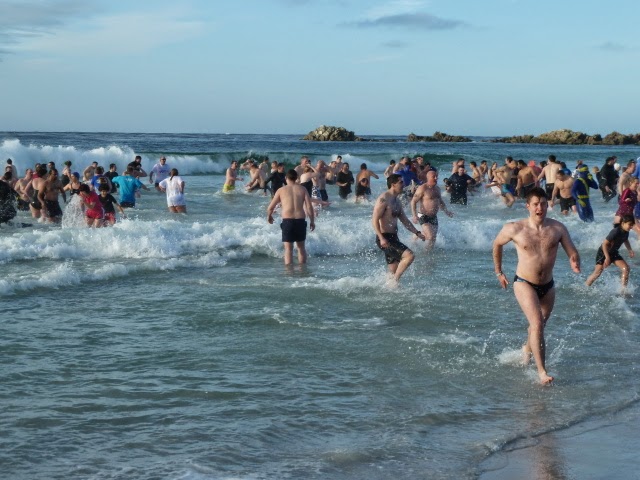
The other major event happening around Stanley is the Midwinter Swim, although not much swimming goes on.   It's more a gentle trot into the waves at Surf Bay, then a sudden realisation that the human body cannot survive long at those temperatures, followed by a sprint back to the beach and the burning braziers.
 Quite a few people dress up for the swim, and a number of penguins were spotted on the beach, although it's not clear which breed they were.
Air Temperature 5C, sea temperature, 2C
The good news is that our days are now getting longer.  This week has provided lovely views of the moon and venus just before dawn.  But today it was cloudy and the stars were obscured.  However, the sunrise was worth getting up for.  In fact, as the sunrise was at 9am, I had been up for a couple of hours before I took the photo below.
Dawn approaching at 8.38
Hopefully, we will get a bit more daylight in the northern hemisphere.  Looking forward to it, but will miss the spectacular skies above the Falklands.

This is an aspect of life here that few tourists get to enjoy.  Most tourists visit in the summer as part of an Antarctic cruise.  Midnight sun is all very well, but the stars and the sunsets can be amazing, too.

Lastly, but certainly not least, the Falkland Islanders commemorated Liberation Day on June 14th, marking 32 years since the islands were liberated from the Argentine invasion force.  Several small ceremonies were also held, including one to salute those who died on HMS Glamorgan on 12th June 1982
HMS Glamorgan memorial
The ship had been providing naval gun support to British troops attacking Argentine positions in the hills outside Stanley.  The ship delayed its departure and was spotted passing near Stanley.  An Exocet missile was launched from land and hit the ship.  Remarkably, due to evading action by the captain, the ship survived, but 14 crew members lost their lives.

As is often said here, "WE WILL REMEMBER THEM".

http://en.wikipedia.org/wiki/HMS_Glamorgan_(D19)

Peter


Wednesday, 28 May 2014

77 Days

[The story so far....30 months ago, I migrated with my wife to the Falkland Islands, deep in the South Atlantic Ocean.  All was going swimmingly, with copious opportunities to watch penguins, orcas, seals, and exotic bird-life, not to mention enjoy the quiet social attractions of walking, dining, quizzing, etc.

Then, last November, my retina started to detach from my right eye.  An emergency evacuation and 3 operations later at the Oxford Eye Clinic, and  I was declared fit to return to the island life.  February was extremely busy for me, guiding many tourists around Stanley, the capital, and surrounding countryside.

Then, on Ash Wednesday (March 5th), the same problem recurred.  Worse, I had just renounced wine for Lent!  Another long and stressful  trip to an eye clinic, this time in Glasgow, ensued.  Luckily, my wife accompanied me this time, and I could transfer all my stress to her..... I had another 3 operations from the excellent people at Gartnavel Hospital.  The surgeon was a star, and I am now back in the Falklands with improved vision.  I was away 77 days......].

While I had been away, the Falklands had changed a bit......
But not that much!  The above photo is of a tall tower block, about the same height as the Shard in London, in Santiago, Chile, which I passed through on my return to the Falklands last week.  The Andes are a few dozen kilometres behind it.  Chile is the most earthquake-prone country in the world, so I'm not sure I would like to live in that building, but the Chilenos do build to a very high standard....
House construction, Sapper Hill
Some Chileans are probably helping build a new housing estate on the slopes of Sapper Hill on the outskirts of Stanley, (population 2,500).  About 70 houses are planned in coming months, and about 20 had appeared in the short time I had been away.  It is reasonably quick to erect kit houses.
A new suburb is appearing
 The infrastructure of roads and lighting had been completed in advance, and now the various plots were being worked on by their new owners.  Many are first-time buyers, helped by Government-backed loans.
New tarmac road, Mink Park
 Another newish development, Mink Park, is about a mile to the west of Stanley and now has a smooth tarmac road to it, instead of the potholed gravel track that I was familiar with. About 15 houses have been built here, with the golf course on one side and the harbour on the other.
The end of the tarmac.... Mink Park.
The road above carries on to the end of the harbour, past about 6 houses at Moody Brook and then over the ridge to Murrell Farm.  The grey building on the left is the old mink farm, probably a victim to the downturn in the fashion for fur coats....  Beyond it, about 2 miles away are Mt Tumbledown and Two Sisters, iconic hills which saw vicious fighting at the end of the 1982 war..  (which lasted 74 days.)
Temporary Port Facility
As well as housing, the oil industry has been gearing up to prepare for more exploration.   The photo above shows the installation of a new temporary port facility (TPF) for the oil industry.  It was towed from Louisiana in March and is being  fixed to the seabed, at the east end of the harbour.  Soon it will have a causeway to the mainland, and it will be a major hub of activity for the oil companies working out of Stanley.
The new TPF from the old FIPASS
The adjacent dock, known as FIPASS, (Falkland Islands Port And Storage System), was also a floating facility but, at 25 years old, is showing its age....
Penguins resting after a hard day entertaining the tourists.
 So, it has been quite an unusual 3-6 months for me, but  I have a lot to be grateful for.  I have my sight. The medical teams who looked after me performed, to my mind, miracles.  Friends, relatives, and even total strangers, have shown me enormous kindness and generosity.  Not to mention my long-suffering wife....
I'm a lucky man!
A cruise ship in the outer harbour, Stanley, from my bedroom.
I will try to respond to everyone who wished me well, but, if you did so, please take this as a BIG "Thank You".  Your thoughts were very much appreciated.

Hopefully, I will be able to update this blog a bit more often, now, but thanks for reading.

Peter

Wednesday, 9 April 2014

Back home - Ayrshire roots

Well, March was an eventful month!

No sooner had I made pancakes on Shrove Tuesday and decided to give up wine and coffee for Lent, than I was booking flights back to the UK for a funeral.

And then, before boarding the first of five flights nothwards, my retina decided to detach, again.  The flights took three long days to carry me to Glasgow.

I was greatly comforted by my wife who managed to accompany me this time. (When I had a similar problem in November, I had to fly to the UK on my own.)

I also had a lapse in my intention to forego wine, reasoning that it didnt count if I was not at ground level....

Heather at the Burns' museum, Alloway
From the airport, we hired a car and drove to Gartnavel Hospital which has an excellent eye unit.  My retina was re-attatched the next day, and I was able to attend the funeral the following day. All very fraught, but manageable with the support of my nearest and dearest, not to mention the superb care at Gartnavel.


 River Doon and the Auld Brig 

So, thanks to my younger brother and his partner, I am now recuperating in my home county of Ayrshire, famous for its bacon and its Bard, Robbie Burns.  He's Scotland's national poet, and I'd be surprised if you werent aware of some of his poems and songs, eg Auld Lang Syne.
A new museum dedicated to him has opened at his birtplace of Alloway, so I took the opportunity to visit it. One of his most famous works, Tam o Shanter, features the bridge in the photo, when a witch, Cutty Sark, chased Tam and his horse across it.


I've also had to visit Glasgow a few times for checkups, and have managed to catch sight of the famous paddle-steamer, the Waverley, on the Clyde in the centre of the city.  Ships like the Waverley carried thousands of Glaswegians "Doon the Water", down the River Clyde, to the holiday resorts of Ayrshire.
L


Ayrshire is also famous for its golf courses, with some such as Prestwick, Turnberry and Royal Troon (above) hosting the Open Championship over the years.  The Open returns to Troon in two years time.


I'll have to keep this short, but I will provide an update on my progress in about a month.  I need another operation, then can start to think about joining my wife again in the Falklands.  Many thanks to those who have sent me good wishes. I really appreciate them.  And I also appreciate the superb care and attention I've received at Gartnavel Hospital. I'm a lucky man.

Peter