Friday, 27 March 2015

End of Summer


Welcome to this occasional look at life in the Falkland Islands, from the point of view of someone who moved here 3 years ago from the UK.......
Huge luxury yachts visit Stanley
Summer (December to February) in the Falklands sees a lot of activity.  Not only do about 500,000 sheep need to be shorn, but about 50,000 cruise ship passengers arrive into Stanley Harbour,  Their ships are either shuttling round Antarctica or plying between Buenos Aires and Valparaiso, via Cape Horn.  .  Many head off by 4x4 to be driven across country to see the penguins.  I lead walking tours in and around Stanley - a very pleasant job when the weather is good, which it mostly was this year.
Small cruise ship doing handbrake turn through the Narrows
 We had one day of heavy rain, and at the halfway point of the walk, we take a minibus for 10 minutes to another location.  However, on that day, everyone was so wet we just headed straight for the penguin colony to at least see some of the Falklands' famous wildlife.

But, usually, most people are happy to walk for 3 hours and soak up the Falklands experience for the day.
Jiggers in the harbour
  And in February, about 100 squid fishing ships (jiggers) from the Far East, call in to collect their licences to fish in Falklands' waters.  Sadly, some crew decide this makes a great opportunity to jump ship, and 9 men tried to swim ashore this year. Tragically, only 7 made it.  They were repatriated to Vietnam.     The day after this photo (above) was taken, a fierce storm blew through the harbour and two ships had to be towed off the shore.  So, even the harbour can be very dangerous.
Memorial to scientists who died in Antarctica.
 Stanley has been the final port of call for ships heading South for over 100 years.  After the exploits of Captain Scott, Ernest Shackleton and others, the scientific research and exploration continued, leading to momentous discoveries such as the hole in the ozone layer, and climate change evidence stretching back millennia.

Recently, a party of (mainly) retired scientists from the British Antarctic Survey raised a memorial to 28 of their colleagues who left Stanley for Antarctica, and never returned.  The most recent to lose their life was Kirsty Brown, who was killed by a leopard seal in 2003.  It is a stunning, and moving,  memorial, and it is the southern part of an installation - the northern part being at the Scott Polar Research Institute in Cambridge.
Winner and 2nd place in the pot plant category.  Well done (and thanks to Edmonde).
March saw the last of the cruise ships come and go.  The next to arrive will be in November.  Life settles down to less esoteric pursuits, such as growing vegetables, and cultivating plants.  My wife won a prize for a spider plant in the Horticultural Show!  The vegetable entries were superb, and our crop of tomatoes stood little chance against competition from gardens which have been regularly fertilised by horse manure for decades!  (Many thanks to our ex-neighbours for leaving us their plants when they left at Christmas!)
The long straight of Ross Road
Last week. saw the very competitive and arduous Stanley Marathon -  the most southerly in the world.  Competitive, as two runners smashed the course record by about 7 minutes.  For a change, the weather was not too windy or cold, merely damp.  But the course is a hilly one and the wind did pick up towards the end, just as some runners were turning into it for the final section.
My shoes, powered by a Zimbabwean de-miner,  running up a steep hill
 It's also very competitive as many runners enter as teams, each of the 4 runners running about 10 kilometres (6 miles).  A group of Zimbabweans, over here to clear some minefields made a request for some running shoes on the eve of the race, and I was happy to hand my size sevens to the chap in the photo above, just prior to the start.
Tim Drew about to take 7 minutes off the course record
The military also enter many runners - the runner-up was in the RAF - and teams of Gurkhas were encouraging each other throughout the course.  None could get near local primary school-teacher, Tim Drew, who had an amazing run.

There were also about 17 Argentine runners, some of whom fly over every year in an attempt to steal the glory and the headlines in Buenos Aires.  However, I doubt the local conditions can be found in Argentina to allow them to train for this event.

As there is only one flight per week, we've had the unusual sight of these runners jogging around Stanley, killing time till their flight tomorrow, back to the South American mainland.
Gaucho...
I'm on that flight, too, as I am hoping to meet up with my wife who has just sailed across the Atlantic on a Royal Mail Ship to St Helena and Cape Town!  Anything to try and experience the golden years of the British Empire!

Hopefully, I can report on how she got on next time.   We are hoping to explore the Chilean Lake District.  We don't see much of Chile on the BBC News, but in the last month, I've watched the reports of huge floods in the Atacama desert, forest fires around Valparaiso, and an erupting volcano in Pucon, where we will be staying.....!!

Never a dull moment!  And, if you are interested in seeing more of life in the Falklands, there's a new series starting tonight of  the BBC2  "Island Parish" !  I'm not sure if it will be available online or broadcast in other countries, but worth looking out for, I hear.
http://www.bbc.co.uk/programmes/b006t6m6/episodes/guide

Peter

Saturday, 14 February 2015

The Iron Lady....in Bronze!

[An occasional insight into life as an expat in Stanley, the capital of the Falkland Islands.]

Where did January go?  :-)

A rare tree, and a luxury yacht in the harbour.
 In Stanley, we had about 20 cruise ships call in on their way to or from Antarctica.  Actually, some of the bigger ships simply sail back and forth around Cape Horn, between Buenos Aires and Valparaiso.

Antarctica, not the Falklands!
As a tour guide, I take groups of tourists around Stanley and/or to the local penguin colonies, explaining the sights that we see on the way.  A new sight in Stanley is the bust of Baroness Thatcher, unveiled by her son, Mark, on January 10th - Thatcher Day in the Falklands.  Funnily enough, I had 4 Argentinians on a tour last week, and all were very scathing of their governments' (past and present) attitude to the Falklands.
Mrs Thatcher, in bronze.
The sculpture is actually very lifelike (although I can't say I ever met Mrs  T.).   It is the work of a very talented sculptor and taxidermist, Steve Massam, who lives in Stanley.  He normally stuffs penguins and albatrosses for the local museum, so to turn his hand to such a sensitive subject was quite an accomplishment.
Summer visitors
Summer has also seen the return of our equine friends, Snow Ghost and Major, who have been wolfing down our grass.  The neigh........bouring plot (geddit?) also had a couple of horses in it and the horses were soon getting to know each other, and comparing the quality of the food.
Piling from a semi-floating barge.
In between cruise ships, work is going on to repair the public jetty in the centre of town.  This is where the tenders from cruise ships unload their precious cargo of passengers.  Sadly, the timbers are feeling the ravages of time, and new piles are being rammed into the sea-bed on the occasional "quiet" days.
Lone penguin annoyed by walker...
 Meanwhile, down at the beach, a lonely King Penguin mooched around while he got his bearings, before rejoining his friends along the coast.
The relatively good weather also saw a good turn-out of Nordic Walkers on the beach.  Although only a kilometre long, the beach usually throws up some surprises like the penguin, or dolphins, so walking there is wonderful.
Walkers not that far from Walkers Creek....
 Once a month, a group of walkers venture further afield to explore other parts of the Falklands.  This month, we drove about 60 miles south-west to Goose Green, where we parked the small convoy, and set off into a strong breeze.
Bodie Creek Bridge, most southerly suspension bridge in the world
 We walked round  the coast for about 7 miles, passing the landmark of Bodie Creek Bridge.  The bridge is unsafe now, but when it was built in the 1930's it saved a 40-mile detour when bringing sheep in to Goose Green for shearing.
Random debris from 1982 war
It was a pleasant Sunday afternoon, and meant we could meet new arrivals to the islands and pass on some accumulated knowledge, for example, where to buy bananas when there's none in the supermarkets!
Snoozebox - new accommodation in Stanley
Back in Stanley, some new additions to the skyline have appeared.  My first thought about the above building was that it might be a new prison, but on closer inspection, it seems to be a no-frills hotel for transient oil workers.  "Snoozebox" is the brand name and apparently they are often used at big events like Formula 1 races.
Stanley sunset
 But if the oil workers are lucky, they might enjoy one of the frequent stunning sunsets we experience in Stanley


Peter

Thursday, 25 December 2014

Santa in Stanley

[An occasional look at life in the Falkland Islands, which are about the same distance from the Equator as London is........]

Christmas Day.  Dawn is around 4.30.  Up early to Skype the rellies.
Gypsy Cove, with penguins
 Put the reindeer in the oven and head to Surf Bay, to have a dip in the South Atlantic with some friends....
"Come on in, the water's lovely!"
 Quite a mild day today, around 15C, and a gentle breeze.  Two years ago it was snowing on Christmas Day!
Luckily, the crowds stay away today
A few days ago, saw a couple of medium-sized cruise ships berth at FIPASS (Falklands Interim Port and Storage System). Interim, in that it was designed to last 5 years, but has been there 25!
Le Boreal and Fram at FIPASS
 The Fram had about 200 passengers and Le Boreal about 500.  I was guiding a group from the Fram around the coast to Gypsy Cove to see penguins, shipwrecks, Steamer ducks, Upland Geese, Blackish Oystercatchers and so on. Lots of chicks, goslings and ducklings to be seen, and several endemic Falkland flowers as well
Fram squeezing through the Narrows
 I also had the great pleasure of bumping into a guide, Rob Caskie,  from Le Boreal, whom we had last seen at Rorke's Drift in South Africa 8 years ago!  We later had a chat over a coffee.  He, too, is keeping a blog of his adventures.
Le Boreal
 Rob's a historian and superb story-teller, and is now telling the tales of Antarctic explorers to cruise passengers heading there.  Back in South Africa, his stories of the Anglo-Zulu wars are captivating. He tours the UK in May, if you want to hear him.  >>>>
http://www.robcaskie.com/blog/post/Falklands-battle-santa/

No job for reindeer...
Meanwhile, back in Stanley, an urgent request was received from a couple of German cruise ships in the harbour.  They had failed to collect the promised Christmas trees from a neighbouring country, and it wouldn't be Christmas for the mainly German passengers without one.  Could the Falklands help??
Santa delivers!
Despite the almost-total lack of trees on the islands, a local market garden came up with the trees and made a special delivery them by zodiac!

Hope you have a Peaceful Christmas and a Happy New Year.

Peter


Sunday, 21 December 2014

1914 Remembered - a violent year in the Falklands.

[A pictorial diary of life in the Falklands for me and my wife.  Here for a few years].

The Falkland Island are, and were, a remote archipelago, and prior to the Panama Canal opening in 1913, Port Stanley was occasionally a safe harbour for ships damaged or blown off course after rounding Cape Horn.  Very much a quiet backwater......

However, on December 8th, 1914, events near Stanley, the capital, brought the Falkland Islands to the notice of the world for the first time.
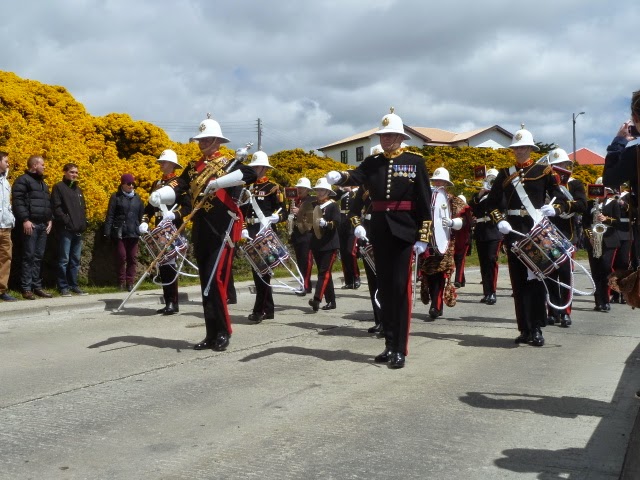
Royal Marines Band
A full-blown naval battle took place within sight of land, resulting in over two thousand deaths, and the crushing defeat of the German fleet in the south Atlantic.
But, just a few weeks earlier, it was the Royal Navy that had suffered horrendous losses in the Battle of Coronel, just off the Chilean coast.  1,600 sailors were killed as British ships were sunk by the stronger German fleet.
Royal Navy
It looked certain that the German fleet, under vice-Admiral Graf von Spee, would then easily capture the Falklands, obtaining vital coal supplies, and destroying the powerful radio station.
Royal British Legion and other civilian groups.
But, reinforcements, under Admiral Sturdee, had rushed to Port Stanley from the north and arrived on December 7th, the day before the German fleet, to surprise the Germans, and achieve a stunning victory.  How different might things have been if the Royal Navy had arrived a day later.....
Memorial wall with plaques about to be unveiled.

"Adversaries in War; Companions in Death"
The sea battles had repercussions, not only for the families of those involved, but also for historic figures such as Winston Churchill (First Lord of the Admiralty, at the time), and also for the long-term strategic importance to Great Britain of the Falkland Islands.
Flotilla of small boats
With my tour guide hat on, I often get asked by visitors, "Why?" Why is this spot on the map British?   "What earthly interest did Great Britain have in a wind-swept archipelago, miles from anywhere and in some of the roughest seas in the world?"
Well, that naval encounter in 1914 brought home to the world how important it was to have a staging post and re-fuelling base, when you are thousands of miles from home.
The Governor inspects the parade
"The Sun Never Set" on the British Empire at that time, and the empire relied on trade, which relied on ships, which relied on coal, and later, oil, to keep their engines running.

In an unstable world, where people were throwing off colonial rule, the Falklands became an indispensable and reliable haven for ships going round Cape Horn to California and Australia, and to explore  "Terra Incognita" - Antarctica.
Marine Band. Battle Monument
So, despite their remoteness, the Falklands had fame thrust upon themselves on the 8th December 1914.  And to commemorate the centenary, a group of locals decided it would be appropriate to invite descendants of the Admirals in those battles to Stanley.

So, the descendants of Admirals Craddock (defeated at Coronel), Sturdee (victorious at the Falklands) and Graf von Spee (victor at Coronel and defeated at the Falklands) were invited to participate in events to mark the sacrifice made by both navies.
Combined parade march past
December 8th is now a public holiday in the Falklands, and a large crowd turned out on a bright and breezy day to see units from the Royal Navy, Royal Marines and Falkland Islands Defence Force march to the Battle Monument, and return to take the salute from the Governor and VIPs.
A new memorial for both sides of the conflict was unveiled, and a flotilla of small ships sailed down the harbour in the brisk south-westerly.
The Marines Band, as they did all week, marched and played stirring music.....
"Hearts of Oak".  "The Great Escape" - yes!  Even some Bond themes!
They are all superb musicians, each playing a minimum of two instruments.
Falkland Islands Defence Force.

Taking the salute at Government House.
"Eyes........Right!"
Flotilla of launches.
Malvina House Hotel flagpoles.
Later in the day, the visiting Royal Marine Band Beat the Retreat in the street, in front of the Malvina House Hotel, where a gala dinner was taking place.  A stirring performance on a cool evening.


Beating the Retreat

At the end of the week of commemorations, another memorial was unveiled, this time by local descendants of 8 members of the Falkland Islands Volunteer Force who died in a tragic accident on December 1st 1914.
Cairn, with the Canache in backround
The men had been hurriedly working on lookout posts, before the expected German fleet appeared in Stanley harbour.  To save time, rather than taking a longer land route, they took a short boat trip across the Canache - a sheltered inlet of the harbour.

While crossing a narrow strip of water, their punt capsized, and, fully-laden with coats and packs, 8 of them drowned a few yards from shore.

The impact of this tragedy on such a small community, on top of the news of the imminent arrival of an invading German fleet, is hard to imagine.

So, it was an emotional week for many.  But the visitors apparently felt that it was such a fitting  gesture by the Falklanders - to bring together the families of the commanders of opposing fleets.

The guests had enjoyed a full programme for their week. When not viewing the famous wildlife or visiting a sheep farm, they were being entertained by the local Amateur Dramatic society, in the shape of a Edwardian Music Hall concert, with the addition of sketches from the BBC Blackadder WW1 series!   A great time was had by all, including the audience!


More details of the Battle of the Falklands can be found here >>>>>

http://www.rmg.co.uk/researchers/collections/by-type/archive-and-library/item-of-the-month/previous/the-battle-of-the-falkland-islands-1914

Have a peaceful Christmas

Peter