Showing posts with label referendum. Show all posts

Friday, 15 March 2013

Referendum Postscript

Dear Reader,

I'm sorry I left you in suspense over the outcome of the Referendum to decide the Political Status of the Falkland Islands (see last week's "Referendum Special").  In case you didn't hear.........
Hard-working counters being Observed by Observer

Fear not!  As many of you may now be aware, it was as I accurately predicted!  A huge turn-out of the electorate: 92%, and a massive majority of 99.8% voting "Yes" to remain a British Overseas Territory.  Three brave people voted against the proposal, one person spoiled their paper, and about 100 people didn't exercise their right to vote.
The secret ballot meant there was no way of knowing how people voted!
The result was declared by the head of the Falklands Islands Government,  a sensible Yorkshireman, who decided, after hearing that a voting paper was missing at the end of the counting process, not to ask for a recount!  His historic announcement was met with cries of joy in the Town Hall and scenes of jubilation on the Whalebone Arch green, beside the Cathedral.
Dick Sawle, MLA, being interviewed by the world's media.
 The many news crews sprang into action, interviewing the politicians and voters in the Town Hall.  Several cameramen moved on to record the scenes of celebration on the Whalebone Arch Green in the Town Centre about 500 yards away.
The pile grows.....
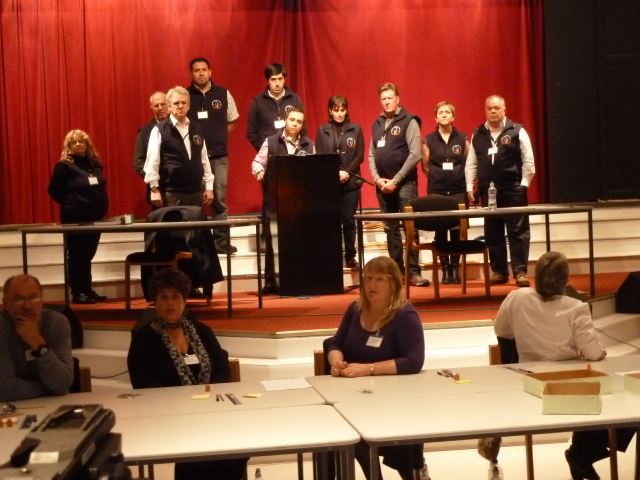
 Shortly after the announcement, the team of Observers reported from the stage that they were satisfied everything had been done fairly and lawfully.  In fact, apart from that one missing vote, everything went like clockwork.  Great credit is due to the team of civil servants (one of whom I'm married to) who organised this in the glare of the world's media.  As one of the MLAs (Member of the Legislative Assembly) said, we usually only see the Penguin News reporter on election nights!
"One of our votes is missing....!"
 There was some surprise expressed about the 3 "No" voters, and some people wanted a 100% "Yes" vote. But as another MLA, Jan Cheek, shrewdly observed, only dictatorships get 100% votes
Whalebone Arch sees some revelry
 Personally, I'm puzzled by the 100 missing voters.  I know some people had to be evacuated to Chile for unforeseen medical emergencies, and couldn't vote.    But, given the constant awareness of the sacrifices that servicemen made 30 years ago to rescue people here from a military dictatorship, I would have thought exercising a hard-won democratic right was a good way of repaying those men...
The Observer  team (or the crew of  the starship Enterprise about to be beamed back onboard.  The Earthlings are friendly...)
PPS -

And I was right about another "prediction" ("Is the Pope a Catholic?") last week. He is, indeed, and an Argentine to boot!

By the middle of the week, the journalists and cameramen were about to pack their cameras and notebooks and do some sightseeing while they waited for their flights at the end of the week.

But suddenly, they were told by their offices to find out what Islanders felt about the new Pontiff.  Never has the local Catholic priest been in so much demand.  The media scrum outside St Mary's Church spilled out onto the road.


Hopefully, normality will resume next week.  But will the Falklands be the same again?

Rambling along the Fitzroy River and Bridge

[This is a snapshot of life on the Falklands Islands, as experienced by someone who arrived in January 2012......While the world's media descend on the place, some of us like to get out into the countryside...]

Referendum Day had arrived, but The Ramblers had a monthly walk to undertake.  With luck, we should get back to Stanley in time to vote (if one was on the Electoral Roll), or to see the planned  rally of several hundred cars through the capital, Stanley.
Welsh Guards' memorial, Fitzroy

 Our walk was a 10-mile circular route around the Fitzroy River, to the Fitzroy Bridge, and past the Fitzroy Settlement. All named after Capt. Robert Fitzroy, who chose Charles Darwin to accompany him on a 5-year surveying voyage, on his ship, The Beagle, which, before reaching the Galapagos Islands, spent some time in the Falkland Islands..   What a good choice of companion that turned out to be!  How different might the world have been if Fitzroy had chosen someone else?
http://en.wikipedia.org/wiki/Robert_FitzRoy  .  Fitzroy was a remarkable man, who went on to develop a system for weather forecasting!
Stanley Growers, Airport road, Stanley.
Our start point was about 25 miles down the main (pot-holed) road from Stanley to Mount Pleasant Airport (MPA).        It was a grey day, but, at least the recent heavy rain had desisted for a while.  However, the streams running down from the hills were swollen, and had no bridges, so local knowledge, in the shape of a couple of people who knew the area like the back of their hands, was invaluable.
Low tide on Fitzroy River
After jumping a few streams without mishap, we came to the wide tidal estuary of the Fitzroy River, where we could walk on the exposed shore.  It was sometimes stony underfoot, sometimes sandy, as the sandstone cliffs crumbled over millennia, under the battering of water and wind.
Exposed sandstone cliff
The sea appeared to reach to the base of the cliffs, so I'm not sure how pleasant a walk it would have been at high tide! However, after about 4 miles walking we came to the narrowest part of the estuary, which was crossed by the Fitzroy Bridge.
Fitzroy Bridge looking north-east.

The bridge was built in the 1930's to avoid a long detour around the estuary between the settlements of Bluff Cove and Fitzroy. It could take sheep and vehicles, and had concrete supports with a wooden platform.  I found out here >
http://www.bridgemeister.com/pic.php?pid=2069   
<  that some of the wood came form the SS Great Britain, which lay rotting in Stanley Harbour for many years, before being saved and restored to its new home in Bristol.
http://en.wikipedia.org/wiki/SS_Great_Britain

Doesn't quite reach the far side.
However, it seems the bridge itself is now in need of repair, as storms have destroyed one end of it.  It is now home to resting cormorants, and hasn't really been in use since the new road to Mount Pleasant was built about 25 years ago.
Parts of the SS Great Britain were used to build the bridge
However, during the Falklands War in 1982, this bridge played a pivotal role in the single biggest loss of British life.   On the night of the 7th June, the Welsh Guards were moved by ship from the beachead area of San Carlos to their new position at Bluff Cove, but, as that was overlooked by Argentine positions, the ships stopped at Fitzroy as dawn broke on the 8th.

(For details of the event, try here > http://www.rna-10-area.co.uk/bluff_cove.html )

The concrete supports provide a sheltered lunch spot
Several factors then combined to create a tragic loss of life.  Those in charge of the landings ordered the men ashore to walk the 5 miles to Bluff Cove, via the bridge, as the ships were so vulnerable to daylight attack.  The Guards' officers refused as there were rumours that the Fitzroy bridge had been blown up (or at least mined by the Argentine forces), so an extended walk might be too much for their men, and, in any case, they had been told they would be taken to Bluff Cove.
http://dalyhistory.wordpress.com/2012/06/07/falklands-30-5-infantry-brigade-and-sir-galahad/

Meanwhile, the Rapier anti-aircraft missile system had been shipped ashore, but not completely set-up.   As predicted, Argentine aircraft soon appeared and bombed the ships, crammed with fully-kitted soldiers.  56 were killed, and 150 wounded, many of them, like Simon Weston, badly disfigured by the ensuing fire.
3 Argentine aircraft were shot down, with 3 killed.
Pink granite fence posts, from Aberdeen?
Using the bridge as shelter from the breeze, we enjoyed hot drinks and sandwiches.  Once replenished, we turned south, up and over the Fitzroy ridge, passing very unusual granite posts, almost like neolithic standing stones found in Europe, except these were of imported stone, and had been trimmed by tools.
Beach, with Fitzroy Ridge ahead.

The uphill stretch opened up views along the hills which ran towards Stanley, 25 miles away to the east.  Soon, we were on the crest of the ridge, and could see beyond the hangars of Mount Pleasant Airport, 10 miles to the west.
North to Wickam Heights, across Fitzroy River. Bridge at narrowest point
We could also see the sheep-farming settlement of Fitzroy to the south-east, nestling between sea inlets.  The sheep which grazed the land we were walking over ran off at our approach.  But some of them were not so mobile.  We passed several dead sheep, presumably killed by the cold.  Along with the weather forecast, the local radio station broadcasts daily warnings for farmers about the sunburn or windchill risk to sheep.
Shear the sheep too early, and they risk being burned in the fierce sun.  Shear too late in the summer, and there's a risk to newly-shorn sheep that the temperature drops below what they can cope with.

Striding over grass and diddle dee.  Fitzroy settlement in distance
As there is little or no shelter, many sheep succumb to the weather.  The vultures clean up the carcasses and prevent diseases.  One of our group was a taxidermist, who is always on the lookout for fine specimens of Falklands' fauna.   One skull we saw had a full set of teeth, and was just what was needed for a display in the Museum!
Someone is  happy to find smiling sheep.....
Eventually, we returned to the cars, just as hail was starting to sting our faces - a reminder that summer is well and truly over.

On arriving back in Stanley, we were in time to witness the huge parade of Islanders demonstrating their desire to remain British.  See recent posts for details and pictures.

An eventful and enjoyable day, allowing us to see parts of the Falklands not many people have seen.  Thanks to Mike and Greta for organising.

Peter

Wednesday, 13 June 2012

Evita, Mr Darcy, and the fight for the Falklands.....

As I write, I've just seen on Sky News a British MP ask the Prime Minister why the UK taxpayer is still making loans, via the World Bank, to Argentina!  Yesterday, a Referendum on sovereignty in the Falklands was announced.  The media spotlight is returning to the Falkland Islands for a few days.  Meanwhile, tomorrow is Liberation Day........

Overlooking Stanley Harbour

In my previous post, I went into some detail about the battle for Mt Longdon.  In the following 36 hours, the entrenched paratroopers were to lose another 4 comrades to the incessant and accurate Argentine artillery.  After going into some detail about the Battle for Mt Longdon, I won't subject you to a repeat.  But, for the British Forces, the battles on the 13th/14th June saw a repeat of the successful tactics which had enabled three hills to be captured on the night of the 11th June:  heavy naval artillery fire and close-quarter fighting at night, using highly-trained young soldiers.

In fact, so effective were the British troops, that captured Argentine officers assumed the decisive advantage had been the use of night-vision goggles.  The couldn't believe that the Task Force only had a handful of these goggles and all had been issued to helicopter pilots and none to ground troops!

http://en.wikipedia.org/wiki/Battle_of_Mount_Tumbledown
Scots Guards - Killed In Action
 The Battle of Mount Tumbledown, and the impact on one participant - Lt Robert Lawrence - was depicted in the film "Tumbledown", starring a young Colin Firth (completely naked in one scene, if anyone needs an incentive to watch it!).
Memorials on Mt Tumbledown

Abandoned Argentine field kitchen 
 Like many of the surroundings hills, Tumbledown has a low cliff of sheer rock around most of its summit, so the defenders had to be engaged bunker by bunker, rock by rock.
North face showing its defensive properties
 About 900 British troops, comprising mostly Scots Guards, attacked the heavily-fortified hill during the night, simultaneously with attacks on neighbouring mountains.
Remains of defensive stone fortifications (sangars) dot the landscape.
 After 10 hours of bitter, hand-to-hand fighting, the high ground was under British control and the street lights of Stanley could be seen about 3 miles away.  At least 40 combatants lost their lives during the night.


Some troops moved on to the next objective, but already it was becoming obvious there was a general retreat of Argentine troops back into Stanley (where the main body of troops were stationed).  It was now the role of the British commander of land forces, General Jeremy Moore, to ensure the Argentines surrendered quickly and didn't prolong the conflict with street-to-street fighting amongst the residents of Stanley.  He moved into the outskirts of the town, and skilfully secured the surrender that day, the 14th.
Tumbledown, with Mt Longdon about 2 miles to the north.
All that remained to do was to round up, disarm, feed and then repatriate 10,000 Argentine troops; rescue 1,800 Stanley residents trapped in various buildings; detect and defuse 25,000 unmapped mines (work pending); destroy hundred of tons of ammunition and weapons;  repair roads, houses, water supplies, airports, as well as return the victorious troops back to their loved ones as soon as practical.
Tumbledown, this week, from near Stanley.
All in all, a shed-load of work which took years to complete, and some, like the mine clearance, remains deliberately incomplete.  (Several soldiers were injured in the aftermath while trying to clear minefields (with captured Argentine assistance), and the commanding officers felt it was too much of a risk for too little reward.)

However, the political and economic post-war resurgence in the Falklands has left a legacy of good schools and health care;  a network of roads (albeit without tar) connecting remote settlements; an international airport; a world-class fishery; excellent wildlife tourism infrastructure; a large military garrison, and the prospect of an oil industry.

The blot on the horizon of this South Atlantic idyll is the Argentine President's continuing call for the Falkland Islands to be "returned" to Argentina.

No Islander takes her proclamations seriously. (She never gives interviews or debates in Parliament, preferring to issue announcements from the balcony of the Casa Rosada in Buenos Aires, a la Eva Peron (Evita)).

However, her lack of acknowledgement of the status of the Falkland Islanders and the huge sacrifices made by both antagonists,  is a great regret to all who feel that the war should have been an end to the matter.

"Those that cannot remember the past are doomed to repeat it".  Tomorrow, and in the future, the Falklanders will remember the sacrifices made on their behalf.

Wildlife tourism - the future's bright.
Peter
Stanley
13th June, 2012