Thursday, 31 October 2013

Peruvian Perambulations. "A" is for Alpaca ......

[Currently, my wife and I are living in the Falkland Islands, an archipelago in the South Atlantic.  We've just taken a break from the penguins, and visited Peru for a holiday.   It was a fascinating trip.   I am trying to break down the reports into manageable chunks, and keep within my monthly Internet allowance.  Seriously.  More later, Peter]

A is for ALPACA.......................

These domesticated Camelids are related to the larger Llama, but won't accept loads, so can't be used as pack animals.  Andean people use them for their wool and for food.  They are delicious......


Experiments are being done to improve the wool yield!

He reminds me of someone.....
"Psst!  Smile - the gringo is taking your photo!"
A is also for ANDES
Arequipa airport and Mt. Misti
The Andes mountains dominate the landscape, but Peru also has a desert region along the coast, and a jungle region on the east of the Andes.
Herds of  wild Vicuna on the high Altiplano
Within the Andes, crops grow in various eco-systems and at various heights.  The Andes gave us potatoes, tomatoes, corn, chocolate and so on.  Hence they can support a much bigger population than most mountainous regions of the world.
At every Andean viewpoint, you find a market.  This was at 4,910 metres/ 16,000ft.   Higher than Mt Blanc!
and A is also for AREQUIPA ...............................................................................
 - a beautiful city, surrounded by volcanoes.
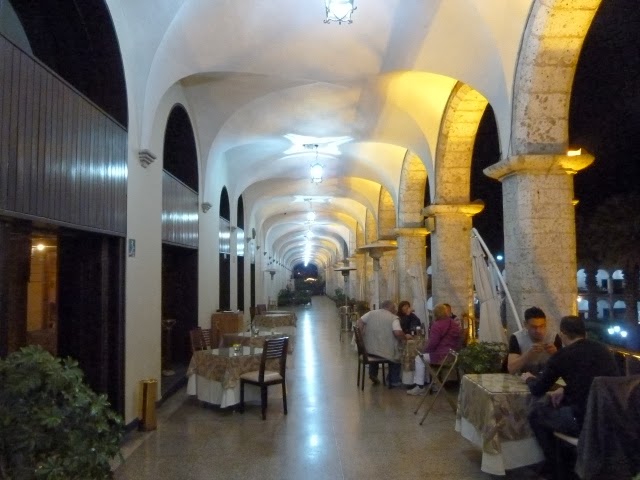
Colonnaded restaurants on the 1st floor, or 2nd floor if you are a local.
Arequipa cathedral at night
The city was near silver mines, which paid for the churches.....
The left tower collapsed about 10 years ago in an earthquake.
The symmetrical main square in Arequipa
At 7,660 feet above sea level (2,335m), the heat of the desert is mitigated, and the problems with altitude are not as severe as other Andean cities.  A pleasant place to acclimatise.
Andes always looming in the background
Within the city, is the huge convent of Santa Catalina, which, until a few years ago,  had been closed to outsiders for 400 years.  The nuns communicated to visitors via grilled windows at the entrance, but within the walls, ran their lives in total privacy.
Santa Catalina Convent - a town within a city.
We took a tour of this fascinating enclave, and it was like stepping into medieval Andalucia!  Wonderful bright colours, narrow streets, ancient kitchens and washing facilities, well-tended gardens....
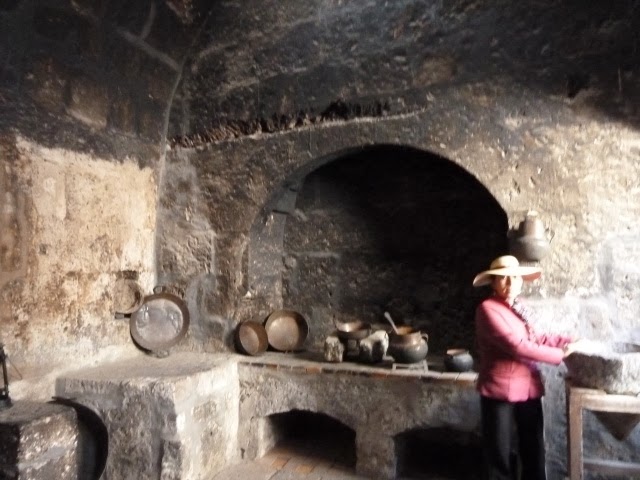
The convent's kitchen
Guinea pigs would keep the floor clean, and be a convenient source of protein....
Calle Cordoba, St Catalina Convent
The prospective nuns would come from wealthy Spanish families and would either stay there for life, or leave after a few years as a novice.

Tourists now roam the streets where, for centuries, only nuns were allowed.
Calle Granada
From a rooftop, one could look over the high walls surrounding the convent, to the mountains surrounding Arequipa.
ChanChani volcano
A few minutes walk away, one could be back in the 21st century and the delights of of the Plaza de Armas.
Arequipa breakfast spot
B is for Ballestas Islands ............................................................................................................
These islands are a few miles off the coast of Peru (near Pisco!), and famous for their wildlife.

On the way, we passed the huge "Candelabra" sculpture in the desert.  A sign for sailors?  Designed by aliens from another planet?  It's about 150 metres tall, and points due south!
The islands used to be rich in Guano, which provided the newly-independent Peru with a huge income in the 19th century as Europe demanded fertiliser for its growing populations.

Now the islands are a Nature Reserve.   As we approached, we could hear, see and smell the thousands of seabirds......
Mining the guano was hard work, and it only stopped when chemists discovered how to make artificial fertiliser.
Every available surface is taken by sea lions, penguins or seabirds.....


C is for.....

Condor - didn't see any, sorry!

C is also for Colca Canyon.............................................................................................
This is a deep, remote valley, about twice as deep as the Grand Canyon in Arizona.

Ancient terraces increase the available land.
A local lady of Colca Canyon.  Hat embroidery indicates family, marital status, skill, worth, wealth, ....


C is for Cross Keys - an English pub at 11,000 feet.  (see "X Keys")

D is for DESERT .................................................................................................................
Most of the country between the Pacific Ocean and the Andes is desert, with occasional irrigated river valleys, providing a sudden belt of greenery.  Many grapevines are grown, as well as asparagus and artichokes and other high-value vegetables.
The Dakar Rally comes through here in January!
Irrigation allows crops in the desert.

Good harbours are few and far between.....
An unstable shore, prone to earthquakes.
Desert dwellings
The biggest surprise for me was that many people live in shacks in the desert, far from any town.  Not only is it free, but it means they may be able to find work in a Natural Gas plant.  Peru is an oil and gas exporter!


E is for Earthquake ......................................................................................................
Our 2-storey hotel had a lift - which we didn't use......
Peru is prone to earthquakes, and October is supposedly earthquake month!  Luckily, we didn't feel the earth move.   But we walked up the stairs, just in case.....

F is for Floating Islands .....................................................................................


On Lake Titicaca, a tribe of people, the Uros, still live on reed islands, which float in the shallow inshore waters.
The moved onto them several centuries ago to escape the ravages of aggressive neighbours such as the Incas.
They now rely on tourism for an income, and some villages are a popular trip from the nearby city of Puno.  But others do not accept any visitors.  Some villagers are wary of outsiders and officialdom, and traditionally they don't pay tax.    However, they don't have electricity, running water or roads!  A little inshore tax haven!

A quick demonstration on how to build a floating island.
Cooking is done carefully.....
Differently-coloured hair braids indicate marital status.
The whole island turned out to wave goodbye....
About 2,000 people live on about 100 islands
F is also for Food! ..............................................................................................

Avocado and poached eggs for breakfast
It was fabulous.  See "Guinea Pig"   (I'm joking!)
Probably the best airline meal I've had.....
G is for....  Guinea Pig.  Photo not suitable for younger readers.......

H is for HUMMING BIRDS! ...........................................................................


My first sightings. And unexpected at 11,000 feet.
and HOT SPRINGS.........................................................................................
Being a volcanic region, there are lots of thermal springs......
J is for JELLYFISH! .........................................................................................

In Paracas, the beach was littered with hundreds of huge jellyfish.  So - no swimming in the Pacific Ocean.


Ooops.  I missed out "I is for Incas"!    I'll post these later when I've overcome a limitation on the number of photos per blog!

Peter


Tuesday, 1 October 2013

Sealion Island - Where giants collide.....

[Another episode of an expat's life in the Falklands.  This week, we had a flying visit to an outlying island, with a good lodge on it - Sealion Island.   Outside, was the wildlife.....]

If you look back to older blogs, you may find that I have posted about Sealion Island twice before.  We have visited it in the last 2 Februarys, but this time we were going at the start of Spring, rather than the end of Summer.

Watchful penguin
Sealion is about 50 miles south of Stanley, off the south coast of the Falklands.  In February, the  breeding season was at an end - the chicks and pups had either left or were about to set off on their big adventure.

"Sorry, we haven't seen your mate"
The adults were regaining their strength and renewing their feathers or fur, so that they could survive the coming winter.
But, this month is the start of Spring, and some visitors had already produced a new generation.
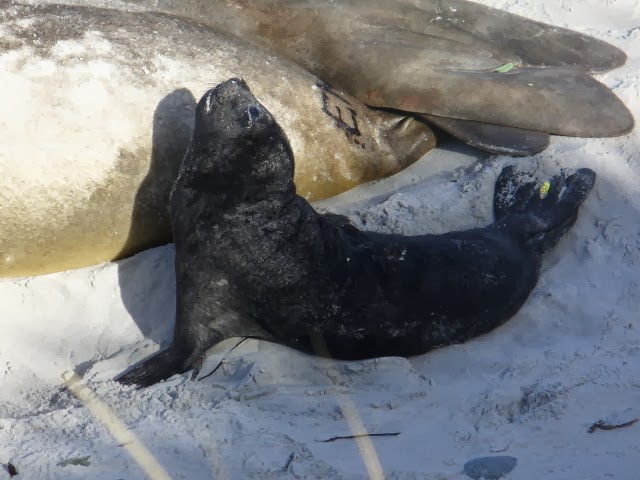
Male Elephant Seal - 3 tons, female, (1 ton) and pup (45kgs)
Huge Elephant seals were dotted along the beaches, with a few dominant males gathering harems around them.  We saw about 20 pups which could only have been a week old.  Their mothers have very rich milk and within 2 weeks, the pups will be left to their own devices (having quadrupled in weight), while their mothers mate and then return to the ocean.
Pup grows to 400lbs (180 kgs) in 3 weeks!
The pups just have to learn to swim and then avoid the patrolling pods of killer whales and then they can set off into the deep!
Magellanic penguin pair setting up home.....
Other differences we noticed in the wildlife was the absence of Rockhopper penguins - (these are due in a couple of weeks) - and also the lack of Skuas, which was quite a relief, as these birds are extremely aggressive in protecting their young.  No doubt they will return soon, when there is more food (eg, young penguins) for their chicks.

Jaunty Gentoo Penguins...permanent residents.
Some birds are on the island all year round.  The large colony of Gentoo penguins is beginning to get into breeding mode.
Elusive and rare Striated Caracara
And there is a rare bird, known locally as Johnny Rook, which is not shy when it comes to investigating visitors.
Hold still!
It's sometimes a struggle to enjoy a packed lunch when these birds are around....
He's let himself go over winter....female and pup on right
But the BIGGEST difference between previous visits, was the size and behaviour of the male elephant seals.  Last February, these guys had been out of the water for about 5 months, and had used up almost all of their food reserves. They were also moulting, and so were a sorry sight.  Like a discarded, worn carpet.
Must keep doing the stretches to get the figure back.....
 Mostly they would lie placidly on the beach, making strange noises from either end of their 5-metre bodies.
Mother and pup
 But now they were at their peak of condition and were competing for the females on the beach.   Some males already had harems which had produced pups (which are the result of mating the previous year).
Dozing in the dunes.  Person in background....
  Others lounged around in the dunes, awaiting an opportunity to sneak into a harem, or have a fight with another male.
Sleeping seal; stupid photographer...
 One one occasion, the peace was shattered when "Eric" (so named by visiting Italian researchers monitoring their behaviour), sneaked out of the surf to mount a surprise attack on the rear of a slumbering Bruno.
An attack from, and on, the rear....
In seconds, the air was full of howling and grunting as the pair squared up to each other, and tried to find a  way to smash their sharp, but small, teeth into the blubber of their opponent.
Let battle commence......
With much pushing and shoving, Bruno made Eric reverse into the sea, where his dominance was clear-cut.
Hard to tell who is winning!
 After a few minutes, Eric realised he had bitten off more than than he could chew, and it would be sensible to retreat and live to fight another day....
And the winner is .... Bruno
 Meanwhile, back in my old stomping ground in Teddington, London, the local park is currently observing the Autumn rut between Red deer stags.  A very similar exercise in natural selection.  I never imagined, as I was enjoying walking round the parks of South-west London, that I would one day be watching wildlife in the South-west Atlantic.
Landing in a gale
After 10 hours walking around the island, we were ready for a delicious meal from the hospitable hostess, Jenny, (who has taken up Nordic Walking!), and then an early night as we had an early flight in the morning back to Stanley.

Just enough time to get up at dawn (6.30am) and watch the seals one last time, before breakfast.  Unfortunately, the Killer Whales failed to appear, although I heard they arrived that afternoon!   We will just have to go back to see them!
~~~~~~~~~~~~~~~~~~~~~~~~~~~~~~~~~~~~~~~~~~~~~~~~~~~
This may be the last blog for about a month, as we are off the explore the land of Paddington Bear.

Continued in November.  Happy Birthdays to half of my family, who seem to have Birthdays in October.

Peter

PS .  Elephant Seal factoid - the male/female size difference is the biggest in the animal kingdom.  Imagine someone 3 times heavier than you making advances.....!

Monday, 30 September 2013

Craft Fair; Feeding Penguin and Big Eggs.

[A life in the South Atlantic, on board the Falkland Islands, some 300 miles of the east coast of South America.....weather improving as we leave winter behind, and the sun returns to the Southern Hemisphere.]


Cutting through the peat
Another exciting period in Stanley, with a new road being cut through a huge peat bank on Stanley Common, at the south edge of town.  This will lead to a new housing development - mostly shared accommodation for seasonal workers, I understand.
The road through the peat
About 40 years ago, most residents would cut peat on the common to heat their houses or use as fuel for their stoves.   Nowadays, only a handful of people still use peat.   But I think it came as a bit of a surprise to see how deep the bank was.  The first Monday in October is a national holiday in the Falklands - Peat Cutting Monday!
Watching penguins near Stanley
A few miles to the west of Stanley are some lovely sand dunes, which is where we took a new friend recently.  Emily had arrived as a teacher in August, but had yet to see a penguin, so we showed her a secret Gentoo colony, guarded by a minefield!  A few days later, we were getting closeup views of a King Penguin.....
Feeding time for a King
An oiled King penguin had been found on a local beach and Falklands Conservation staff had taken it to their de-oiling facility, in Stanley
Temporary home
However, removing the oil also means the bird's feathers are not waterproof, so going back into the freezing sea is not an option until the waterproofness returns in a few weeks.  Volunteers were sought to help feed the bird while it regains its water-repellence.   How could I refuse?  Another sardine?
Nordic Walkers enjoying the sunshine
The good weather has also encouraged more Nordic Walkers out to exercise in the countryside around Stanley.   I have been busy recently working as a driving instructor (harder than it sounds in a country with no traffic lights or roundabouts), so not been able to devote as much time to Nordic Walking.  However, it is gratifying to see people enjoying it on their own or with friends.  Have poles, keep fit.
~~~~~~~~~~~~~~~~~~~~~~~~~~~~~~~~~~~~~~~~~~~~~~~~~~~~~~~~~
Historic Quilt
The local secondary school recently was the venue for a Craft Fair which displayed  many examples of the skills of residents.  Particularly impressive were the quilts - some of which were works of art, and had taken many man-hours (or, more correctly, woman-hours) in the making.
Second prize for Hilary
 The quilt below was created by a friend, and shows scens from Falklands' life, such as the small planes that connect the remote communities.
'Windows on Falklands', quilt
There were categories for knitting, weaving,  felting, model-making, photography, crocheting, leather-work, wood-turning and so on.  There was even a category for cured animal skins and the winner was a rat, which I assumed had been one those killed in the recent rat eradication programme on South Georgia!
Winner of the skin contest....

A local bird, a crested Caracara, in felt.
 What people can do with wool is amazing......
A live crested Caracara, in life
~~~~~~~~~~~~~~~~~~~~~~~~~~~~~~~~~~~~~~~~~~~~~~~~~~~~~~~~~~
The Legislative Assembly has been dissolved, which means a new one, comprising 8 Members, will be elected in November.  There will be 5 Members representing the Stanley constituency, and 3 Members representing the rest of the country (also known as Camp).

Street furniture
So, the next few weeks should see a lot of debate about things that Falkland Islanders hold dear.  Building a port for the oil industry; tarmacing the main road to the airport; subsidising rural life - these are all issues which generate strong debates every so often.
Goose egg, plus hen eggs
Unfortunately, I will miss much of the debate, as I am going away for a few weeks to see a bit of Peru.
The new neighbours
I expect there will still be some public meetings being held on my return, as there are more candidates than seats, so many candidates will no doubt be promising change when (or if) they are elected.  More on this topic in a month or so.
Handy size
Meanwhile, Spring is showing evidence of arriving in the Southern Hemisphere.  Penguins and seals are gathering on the beaches to breed.  Indigenous birds such as the Upland Geese, are laying eggs, which make a change from the normal chicken eggs.
Fills the pan
More on the wildlife of the Falklands in the next posting.   Oh, and the Conservation Ball was held on Friday, and several guests cutting a fine figure and showing shapely legs.  And the women looked smart in the ball gowns, too!  

Have you worked out what is worn under the kilt, yet?

More soon,

Peter