Showing posts with label rockhopper. Show all posts

Wednesday, 16 December 2015

Saunders Island revisited!

[This is an intermittent archive of my life, with my wife, on the Falkland Islands, roughly 400 miles east of Argentina, in the South Atlantic].

There's a saying about London buses, that you might wait for one for ages, then three turn up at once.....  Well, I have lived in the Falklands for 4 years now, and until this month (January 2016), had not been on Saunders Island - one of the premier wildlife locations here.  Then, I visited it twice in one week!
One of several empty beaches
As I mentioned in the "Antarctic Adventures" post, the finale to an amazing trip to Antarctica was enjoying the spectacular scenery and wildlife on Saunders Island - long, sandy beaches and thousands of penguins and albatrosses.
Growing albatross chick
By a coincidence, my wife had booked, weeks previously, a weekend trip to Saunders for the following week.  We were saying farewell to some friends who were returning to the UK, and they, too, had not been to Saunders, either.
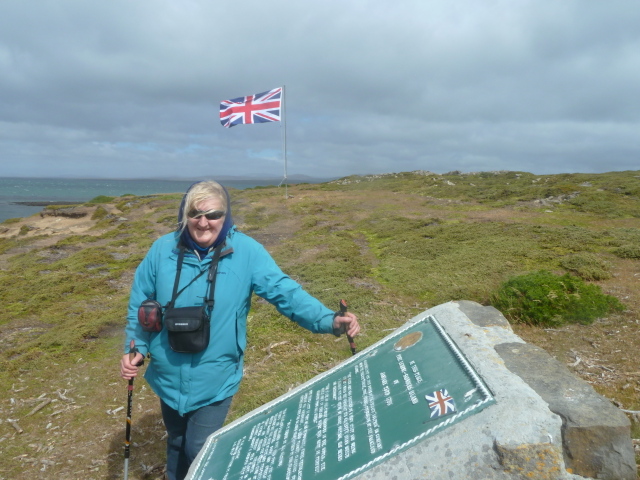
Port Egmont. Union flag raised in 1765.  Taken down again in ....1770.
 As well as the wildlife, Saunders Island is famous in these parts as the place where the British flag was first raised, in 1765. Unfortunately, a year earlier, the French had raised their flag on a nearby island....  Neither party knew of the other's existence for about another year.  After a few years, Britain withdrew from the islands, but returned in 1833, when the French and Spanish had also abandoned the region.  The garrison ruins are still clearly visible.
https://en.wikipedia.org/wiki/Port_Egmont
Watching the albatrosses at the Rookery
 We had enjoyed the wildlife so much the previous week, that we couldn't wait to see more.  We had been at the Neck when we had landed from the Akademik Vavilov, our ship.   This time, we got a lift to another part of the island, the Rookery, which had large Black-Browed Albatross and Rockhopper Penguin colonies.

As there were only about two other people in the vicinity, we had the birds almost to ourselves.  And we could sit and watch the parent and chick interactions for hours, without disturbing them.

Once the chicks leave the nest, they spend about 4 years circling the globe, living on the wing. They then return to the Falklands to breed.
Busy parents
 The birds are ungainly on the ground, but the almost-constant wind around the Falklands enables them to effortlessly soar and glide when they take off.
Note the feet!
 Whilst feeding their chicks, these beautiful birds might travel to waters around Tierra del Fuego to feed.  Around 1200 miles there and back in a couple of days.  We may well have seen some of these birds during our voyage from Antarctica, earlier in the month.
Rockhoppers with chick.
 Close by was a large colony of Rockhopper penguins, whose chicks were now old enough to be left in creches while the adults went out to sea to fish each day.
Rock shag and large chick
Another empty beach, or it might be the same one.
 After we had had our fill of flying and flightless wildlife, we set off back to the settlement along the Land Rover track.  I'm guessing it was about 6 miles.
Different empty beach.  Keppel Island across the water.
 We saw no-one else for 3 hours.  Blue skies, warm breezes... Enjoyed a picnic on the beach.  It's not always like this!
Good track
 The path gradually climbed up to a saddle, just below the summit of Mt Egmont, at about 1,500 feet, so we took a slight detour to the top and drank in the views.
Mt Egmont summit
 The views were extensive - the settlement and airstrip below us; West Falklands, to the south;   Keppel and Pebble Islands to the east, and the extent of Saunders stretching to the Neck, to the west.
Settlement below Mt Egmont
Back in the settlement, which is basically a farm with about 20 buildings, we could enjoy a veritable multitude of domesticated animals - pigs, ducks, geese, horses, lambs, cows, chickens - not to mention the wild Striated Caracaras, Upland Geese, Magellanic Oystercatchers, Kelp Geese, and so on.
Farm guard
Pate
The shearing gang were about to arrive to separate the 3,000+ sheep from their wool.  It was a busy time of year, with dozens of visitors coming and going every week, plus cruise ships calling in.
Saunders airport
All too soon, our weekend break was finishing.  Our FIGAS (Falkland Islands Government Air Service) flight arrived and we clambered aboard.  
Buzzing the ferry on its way to the West.
Ten minutes later, we dropped off a couple of passengers at Pebble Island, then headed back across Falkland Sound to East Falkland and Stanley.
Central Stanley 
Flying low over Stanley harbour, we could easily make out specific buildings in the town.    The blue roof covers the Town Hall, court and Post Office.   To the left, the bank.  To the right, Penguin News office, and Historic Dockyard Museum.
Stanley
Had it been worth going back so soon?  Well, I would say so.  The bird colonies had been different, and we had been almost entirely alone for the day.  And instead of squeezing into a zodiac and zipping through the waves to our ship, followed by dinner with the Captain,  we had a convivial dinner, with wine,  listening to friends recounting their bumpy rides to and from the Neck and their close encounters with King penguins.

Same island, different experiences....    I'd go again!

Saturday, 13 December 2014

Bleaker Island revisited - Birds and Beaches.

[Continuing the irregular updates on life in the South Atlantic.  8,000 miles from the UK, 400 miles from Argentina, the Falkland Islands are our home from home.  While we work during the week, we try to explore the other 778 islands at the weekend.......]

A few weeks ago, we revisited Bleaker Island after our first trip there, about 30 months.
ago.  It's a long, narrow island, about 15 miles by 1 mile, with a small settlement of about 4 houses in the middle.
Bleaker air terminal
As usual, the normal way to arrive is by small Britten-Norman Islander planes run by the Falkland Islands Government Air Service (FIGAS).

An extra passenger on our plane....
We were met by the owner, Mike, who lives on the island, and one of the couple who manage the farm and visitor properties.  Our bags went with the manager directly to the settlement about 2 miles from the airstrip, while we had the circuitous familiarisation tour from Mike.
Cassard House sun lounge
We had stayed in the main house, Cassard, soon after it had opened 3 years ago, and it was still as full of light and comfort as we remembered.  And, once again, we had managed to pick a time when we had the 4-bedroomed place to ourselves.
Cassard House living room
After settling in, we slapped on the sun cream and headed out to see what we could see.....
Settlement house
The main difference from the previous visit was in the season - Spring instead of late Summer/Autumn.  Birds, especially penguins, were sitting on eggs.  This made them much less mobile and hence photogenic.
Rockhopper incubating egg
 They are also very wary of losing their eggs to predators, of which there are many.  The common (to these parts. They are rare everywhere else.) Striated Caracara is mainly seen hanging around colonies, waiting for a moment of opportunity to steal a meal.
Watchful penguins being watched by a Straited Caracara
These Caracaras tend to attack their prey by running, and have been very successful on islands where cats have not been introduced, such as Bleaker.
Striated Caracara

"This way, chaps!"
Other predators include Skuas, and the ubiquitous Turkey Vulture.  So these penguins have a hard life.  Added to that, their colonies tend to be at the top of sheer cliffs, which they have to negotiate hundreds of times during the breeding season.
Turkey vulture
Once they have clambered down the slope to the sea, they then run the guantlet of seals and sea lions, who also use the island for breeding
Southern sea lion
We could sit and watch these cute penguins for hours, and frequently did!


Rocky!!
They are inquisitive
Bleaker also has colonies of Gentoo and Magellanic penguins.  The latter live in burrows near a sandy beach, whereas the Gentoo are usually found inland.  However, around feeding time, they return from their fishing trips and congregate on the beach before heading en masse to find their chicks.
Walking among the Gentoo penguins
Watching the crowds reminded me of my time working in central London, when office workers would gather, at the end of the day,  at the major train stations, perhaps meeting friends for a pint, before heading home to the family!

By the way, this beach has been deemed to be the 9th best beach in the world by a travel writer, Lee Abbamonte, and who are we to argue?  I'm guessing it was also the quietest and coldest on his list, see below!

http://www.leeabbamonte.com/30-best/30-best-beaches-in-the-world.html
Kelp Geese, male white
Birds abound on Bleaker.......
Patagonian crested ducks
Ruddy-headed goose and goslings
Two-banded plover
Crested Caracara, a long way away...
And the birds we saw, were generally very tame, the exception being the Crested Caracara, a striking South American raptor.
Rock cormorant colony
We noticed other differences in the time of year.  The Skuas were here, but had no chicks yet, so were not as aggressive as we remembered.
Skua - pirating gentoo eggs.
 They were feasting on penguin eggs.  In a few months, they would be feeding their young on the abundant penguin chicks!
Gentoo on egg
However, the resident striated Caracaras were an aerial threat.
Agressive Striated Caracara
The next day, we borrowed a car to drive to some of the remoter parts.  Unlike any other car I had hired in the past, there was no forms to fill in;  no credit card to be checked;  no examination of the bodywork for dents and scratches; no queue at the depot; no worry about re-filling with fuel.....

"Would you like to take the car tomorrow?  We'll add £xx to your bill."    Simples!
Magellanic penguin snuggling up to Flightless Steamer Duck!
Most of the island is rough pasture for sheep and beef cattle, but stock numbers are low, to avoid over-grazing and erosion, which has blighted some islands.
So, off we went to explore, and see what we could see.  At the southern end of the island, where we could look across a narrow strait to the mainland, we found a rather friendly Flightless Steamer Duck and a Magellanic Penguin, keeping out of the wind.  Could there be a new species on the way?
Black-necked Swan
We could drive almost anywhere on the farm tracks, stopping for a walk or picnic or to watch a pond for exotic birdlife..  Very relaxing.
A very shy bird is the black-necked swan.  We saw about 8 of them, but almost immediately they would paddle across to the far side of a large pond.
Magellanic Snipe, from the car!
Less shy was a magellanic snipe.  This photo, above, was taken from a few feet away, while we were sitting in the car!

We saw so many more birds that we took photos of.  But we were only there to soak up the atmosphere and relax, which we did, thanks to Elaine, our hostess, having dinner ready for us when we arrived from our wanderings.

Bleaker - a beautiful island.  A really civilised retreat!.